Walk into almost any village in India and you'll find it: a massive tree with roots dropping from branches, forming what looks like a forest but is actually a single organism. This is the banyan (Ficus benghalensis), India's national tree and one of the strangest plants on Earth.
The banyan doesn't grow up. It grows out.
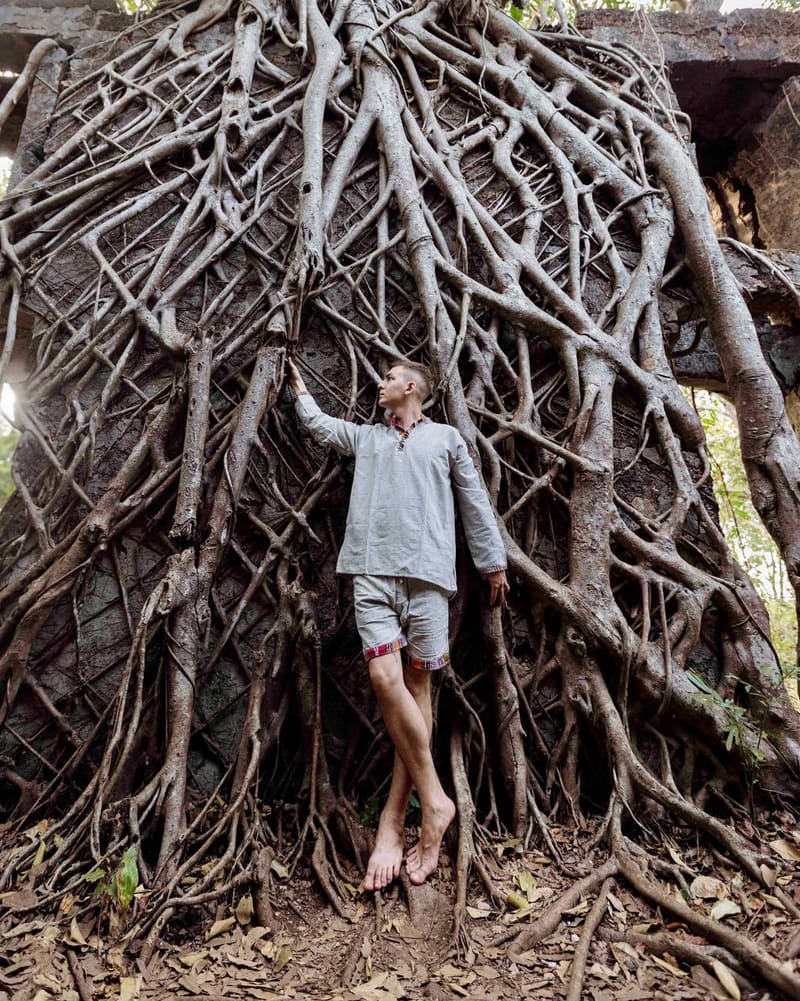
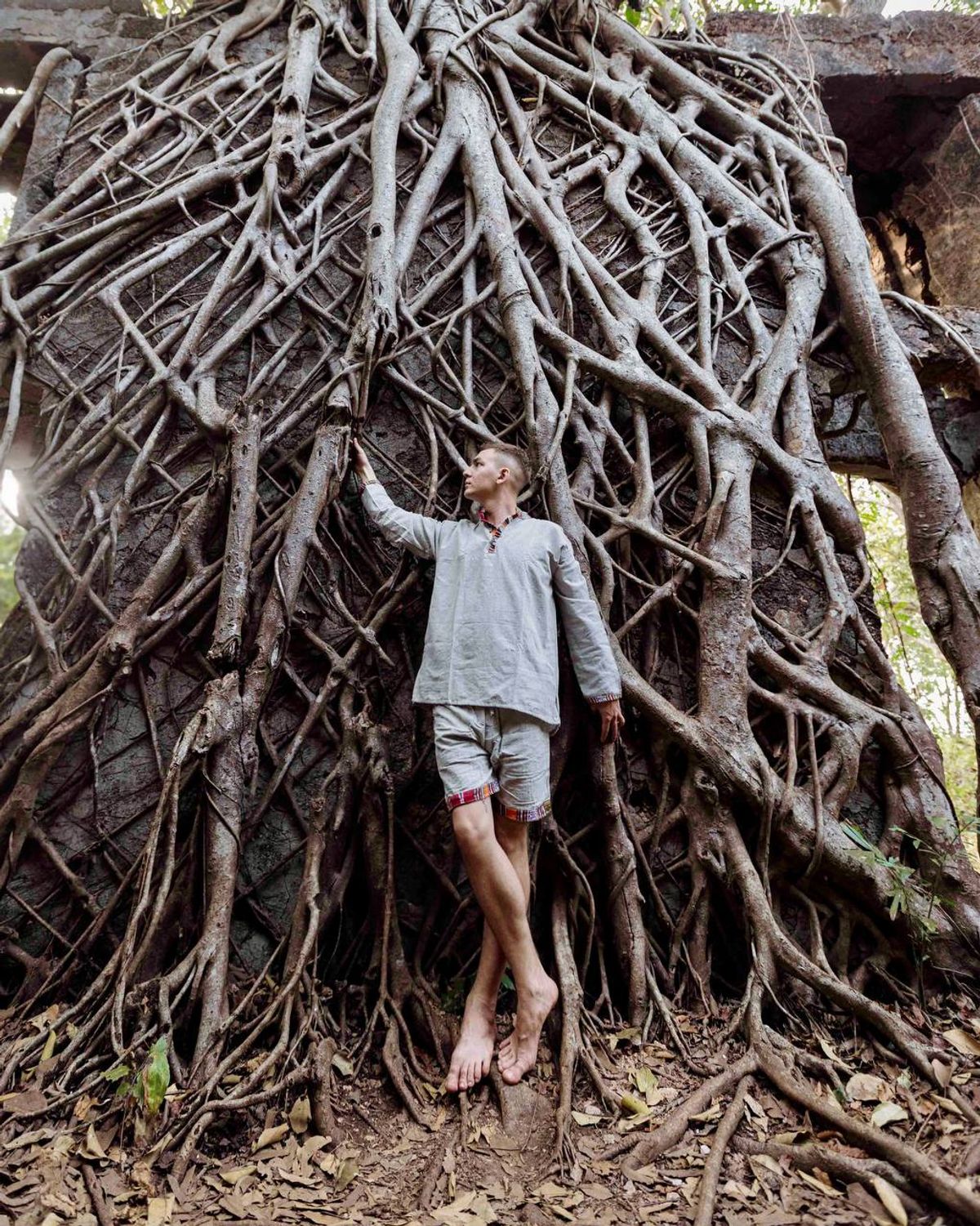
From its horizontal branches, thin aerial roots descend toward the ground. When they reach soil, they anchor and thicken, eventually becoming trunks indistinguishable from the original. The tree expands outward indefinitely, creating its own support structure as it goes.
One tree can cover acres. One tree can look like a hundred.
The Largest Tree in the World (By Area)
In Andhra Pradesh's Anantapur district, in a semi-arid region where annual rainfall barely reaches 500 mm, stands Thimmamma Marrimanu — the largest banyan on Earth by canopy area.
The numbers: 19,107 square meters. Roughly four football fields. More than 1,000 aerial prop roots have become secondary trunks. The tree is around 550 years old.
For context: California's General Sherman, the largest single-stem tree by volume, covers just 1,487 square meters. Thimmamma Marrimanu spreads across nearly thirteen times that.
The tree was entered into the Guinness Book of World Records in 1989 after journalist Sathyanarayana Iyer documented it and brought it to international attention. By then it had stood there for five centuries, quietly expanding, known mostly to villagers who considered it sacred.
The name itself tells a story: in Telugu, "marri" means banyan and "manu" means trunk. Thimmamma, according to local legend, was a woman who performed sati (self-immolation on her husband's funeral pyre) in the 15th century. The tree is said to have sprouted from one of the wooden poles of that pyre. Today, couples hoping to conceive come for blessings, and plucking a leaf is said to bring misfortune.
A strangler fig that consumed its original host and now stands alone. Living sarcophagus. Forest of one.
The Great Banyan of Kolkata
Near Kolkata, in the Acharya Jagadish Chandra Bose Indian Botanic Garden, another banyan holds a different kind of record.
The Great Banyan is approximately 250 years old. Its canopy covers 18,918 square meters with a circumference of 486 meters. It has 3,772 aerial roots reaching the ground as prop roots.
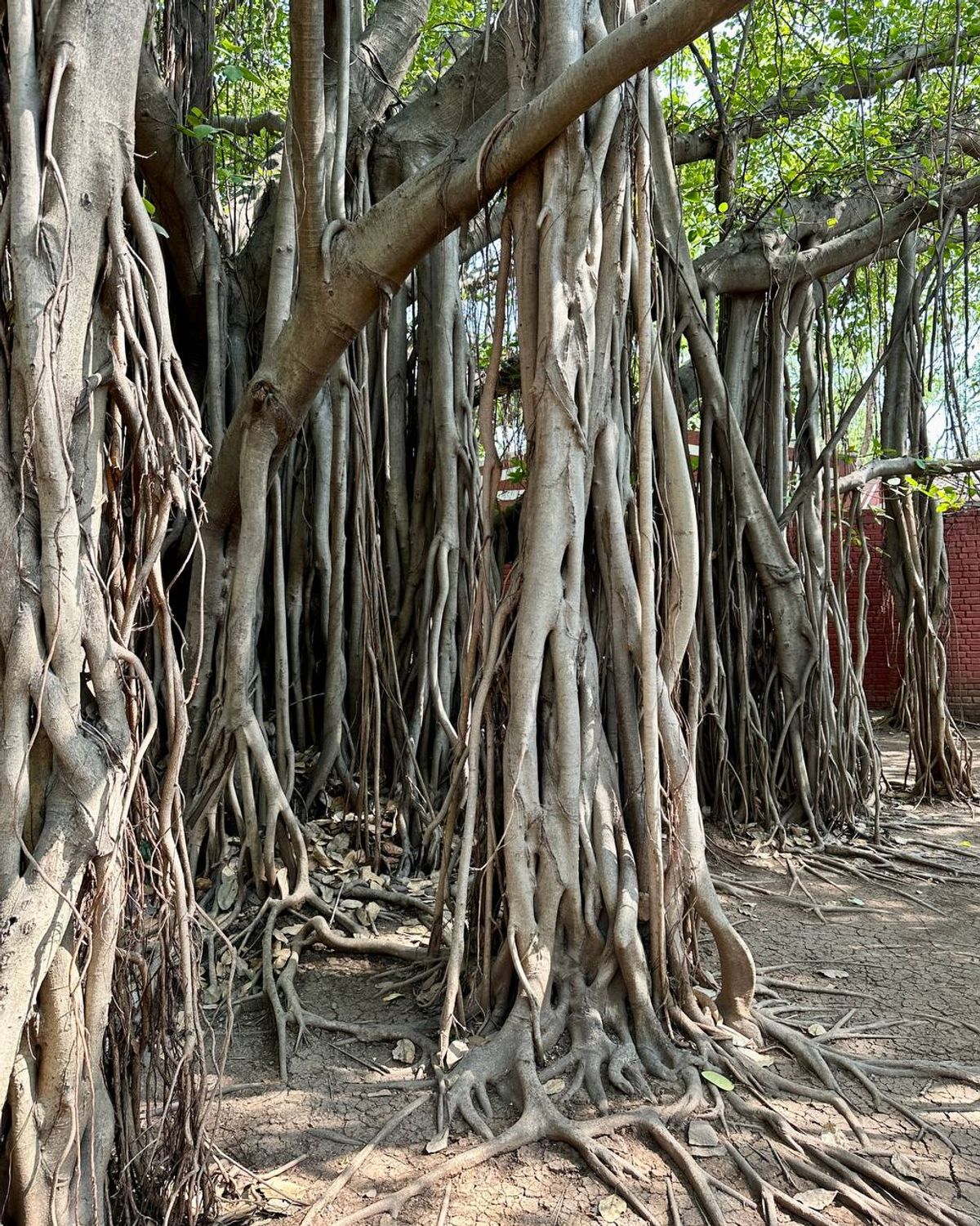
Here's what makes it remarkable: the original trunk died.
In 1925, after two cyclones and a fungal infection, the main trunk was surgically removed to save the tree. A monument marks where it stood, but it's barely accessible inside the thick tangle of roots and branches. Visitors rarely venture in — they walk the perimeter instead.
The tree survives without its heart. It has no center anymore, just an expanding ring of interconnected trunks, each holding up part of the whole. The Great Banyan has survived cyclones in 1864, 1867, and 2020, losing major branches but continuing to spread.
How a Banyan Begins
The life cycle explains everything strange about this tree.
Banyan seeds are tiny and almost never germinate on the ground. They typically sprout in the crevices of other trees, deposited there by birds that have eaten the figs and passed the seeds through their digestive tract (which actually improves germination).
The young banyan grows as an epiphyte, leaning on its host for support. It sends roots down toward the soil while its crown reaches for the light. As those roots thicken, they wrap around the host. Eventually they strangle it — blocking light, competing for nutrients, exerting physical pressure.
The host dies. Its remains rot away, leaving a hollow column inside the banyan's trunk.
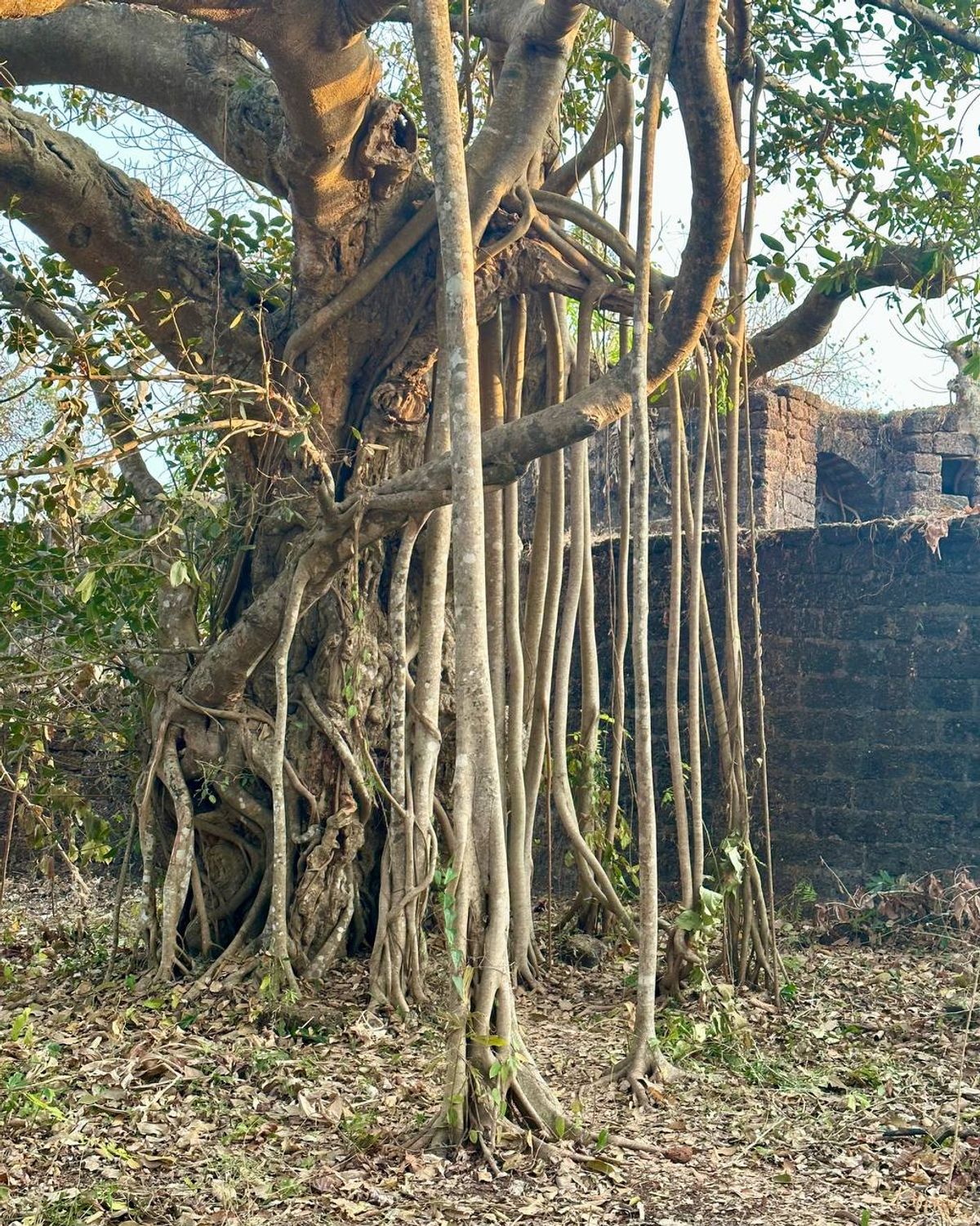
This is why banyans are called "strangler figs." They begin as parasites, become assassins, and end as monuments to their victims.
But that's only the beginning. Once established, the banyan's horizontal branches send down more aerial roots. These roots are thin and fibrous at first, but they lignify — become woody — as they anchor into soil. Each becomes capable of supporting the branch above it. The tree spreads outward in all directions, limited only by available ground.
A single banyan can colonize enormous areas this way, expanding over centuries without ever growing particularly tall.
Sacred Geometry
The banyan's status as India's national tree reflects something deeper than mere size.
In Hindu tradition, the tree represents the Trimurti — the three supreme deities. Brahma (the creator) is symbolized by the roots. Vishnu (the preserver) is the trunk. Shiva (the destroyer and transformer) is the branches. The whole tree becomes a living diagram of cosmic principles.
The Bhagavad Gita references the banyan specifically: Lord Krishna says "I am the Banyan tree among trees." Hindu texts over 2,500 years old describe a cosmic "world tree" — an inverted banyan with roots in heaven, extending blessings downward toward Earth.
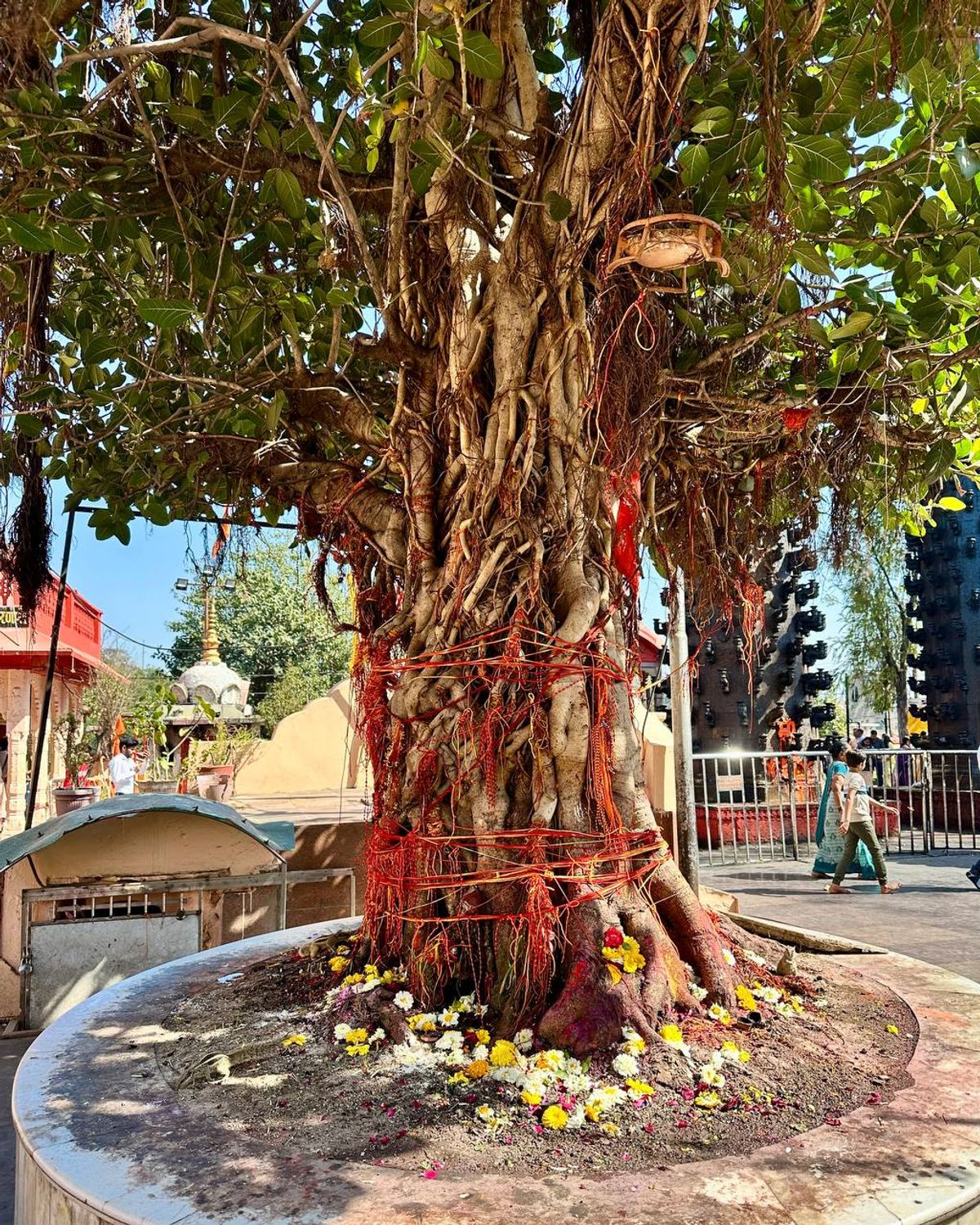
Married women traditionally perform rituals around banyan trees, praying for their husbands' longevity. The tree's apparent immortality — its ability to replace dying parts with new growth, to survive the loss of its original trunk — makes it a natural symbol of continuation.
But the tree's significance extends beyond formal Hinduism. Walk through India and you'll find banyans serving as:
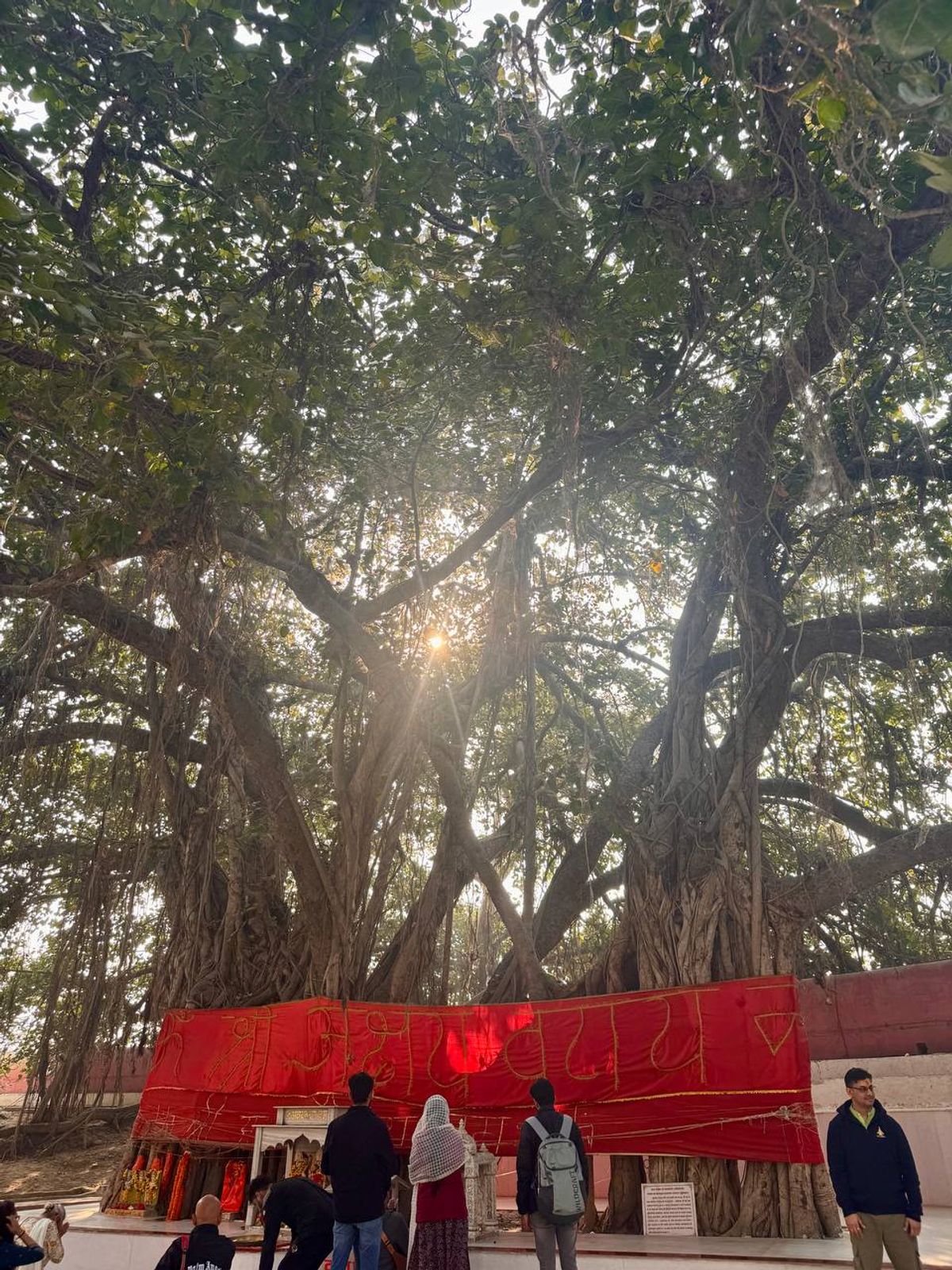
Open-air temples: Statues of deities placed among the roots. Shiva, Hanuman, Devi — whoever the local community reveres. Oil lamps, coconuts, rice, bananas as offerings. Threads and bracelets tied to branches by women with prayers for protection.
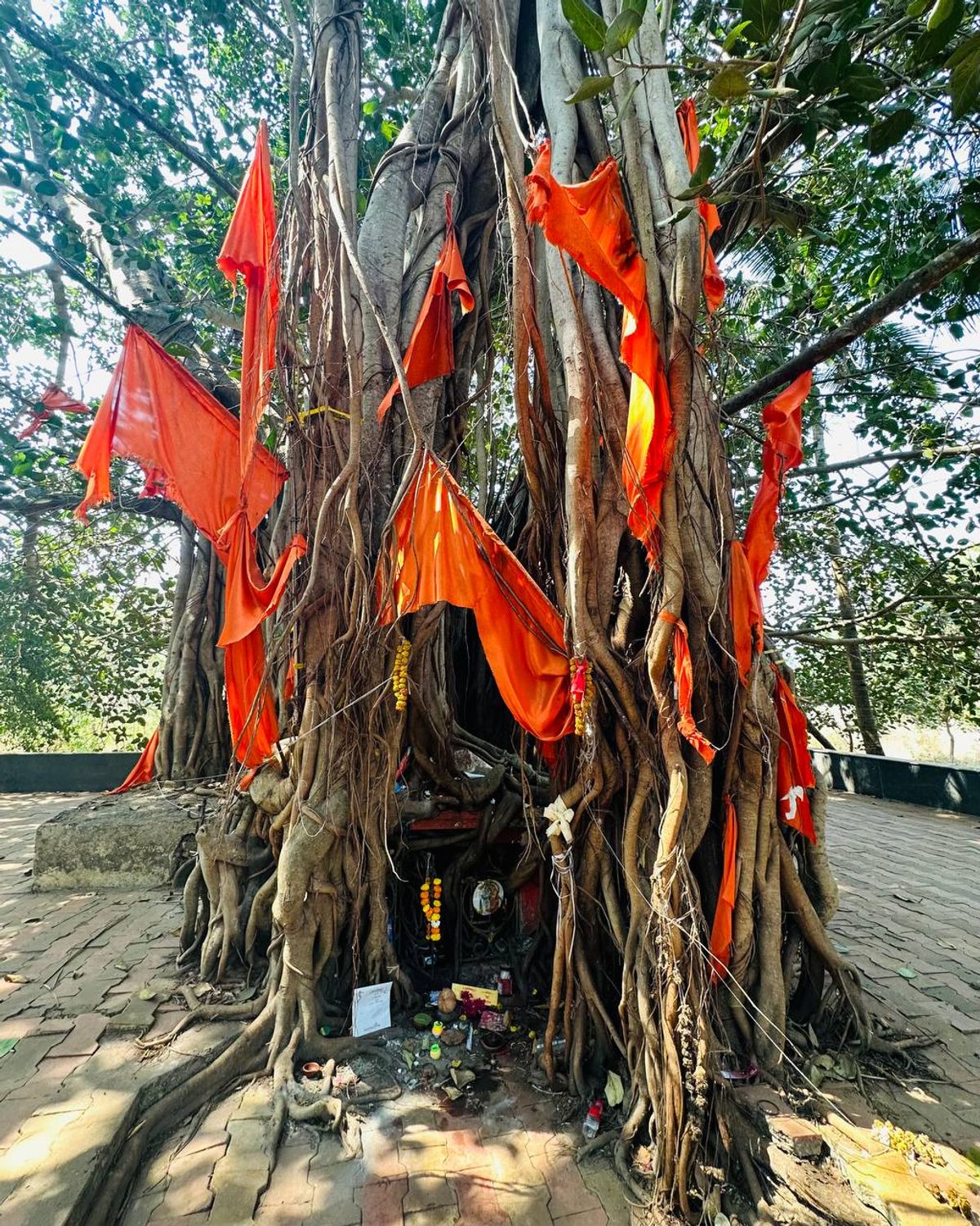
Village centers: The panchayat (village council) traditionally meets under the banyan's shade. The tree becomes a courtroom, a marketplace, a gathering place for celebrations. Entire communities organize around a single tree.
Meditation sites: Sadhus, yogis, gurus have always gravitated to banyans. The dense canopy creates cool shade even in intense heat. The root structure provides natural seating areas. The silence under a large banyan feels different from ordinary quiet.
The name "banyan" itself comes from commerce: British colonizers observed Hindu traders (banias in Persian) conducting business under these trees and named the species after them.
The Immortal Banyan of Prayagraj
In Prayagraj (formerly Allahabad), near the confluence of the Ganga, Yamuna, and mythical Saraswati rivers, stands the Akshayavat — the "Immortal Banyan."
"Akshaya" means indestructible. The tree is believed to be over 5,000 years old, to have existed since the Satya Yuga (the first of four Hindu epochs), and to be destined to survive the destruction of the universe itself.
The mythology: During the cosmic dissolution (pralaya), when all worlds were submerged under primordial waters, the sage Markandeya floated helplessly in the infinite ocean. He beheld Lord Vishnu in infant form, lying on a single banyan leaf above the waters. The Akshayavat represents that eternal principle — what remains when everything else ends.
The history is equally dramatic. When the Mughal Emperor Akbar built his fort at Prayagraj in 1583, he enclosed the sacred tree within the military compound. According to local tradition, he tried to destroy it — had it chopped and burned repeatedly — but the tree kept growing back. Jahangir reportedly drove a red-hot iron cauldron onto its stump. Within a year, it sprouted again.
The current Akshayavat stands in the Patalpuri Temple within Allahabad Fort. For years, access was restricted due to its location in a military zone. Recent developments have made it more accessible to pilgrims, who consider a visit to the Akshayavat essential for completing their pilgrimage to the Triveni Sangam.
Chinese traveler Xuanzang, visiting in the 7th century CE, described human bones surrounding the tree — remnants of a practice where pilgrims would leap from its branches into an adjacent pond, seeking moksha (liberation from rebirth). The practice was eventually suppressed.
What the Banyan Teaches
The banyan's biology offers a particular kind of wisdom.
It survives by creating its own support. Rather than growing a single massive trunk (like the sequoias of California), it distributes structural support across hundreds of smaller trunks, each capable of sustaining part of the whole. No single point of failure can destroy it.
It replaces what it loses. When branches die, new roots compensate. When the original trunk rots away, the peripheral growth continues. The Great Banyan of Kolkata has no center — and that's precisely why it survives.
It expands horizontally rather than vertically. In environments where height provides no advantage (the banyan doesn't need to compete for sunlight in quite the same way as forest trees), spreading outward maximizes the resource base while maintaining stability.
It began as a parasite. The strangler fig strategy isn't pretty, but it works. The banyan takes what it needs from established structures, then outlives them. Indian philosophy doesn't flinch from this aspect of the tree's nature — creation and destruction intertwined.
Living Among People
Unlike sacred groves that require removal from human activity, banyans thrive in proximity to people.
Villages formed around them. Markets operated under them. Children played in their aerial roots. The banyan was never a monument to be admired from a distance — it was infrastructure, gathering space, worship site, and symbol all at once.
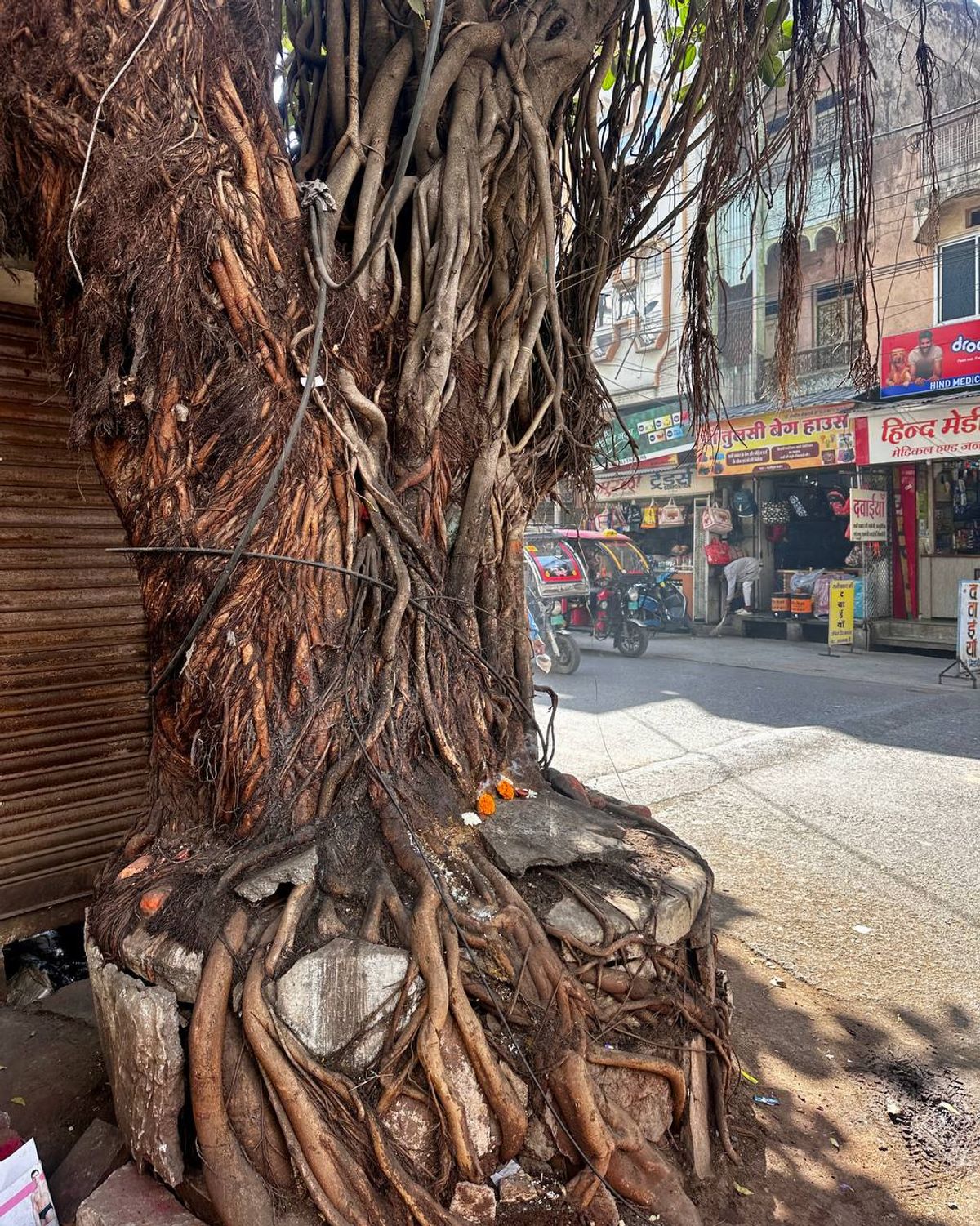
This integration is declining in urban areas, where banyans are cleared for development. Their root systems, after all, can crack concrete, damage foundations, overwhelm smaller structures. What makes them resilient also makes them inconvenient.
But in rural India, the relationship continues. The tree that might shelter a small temple, host weekly markets, and provide the only significant shade in the village still exists in thousands of places.
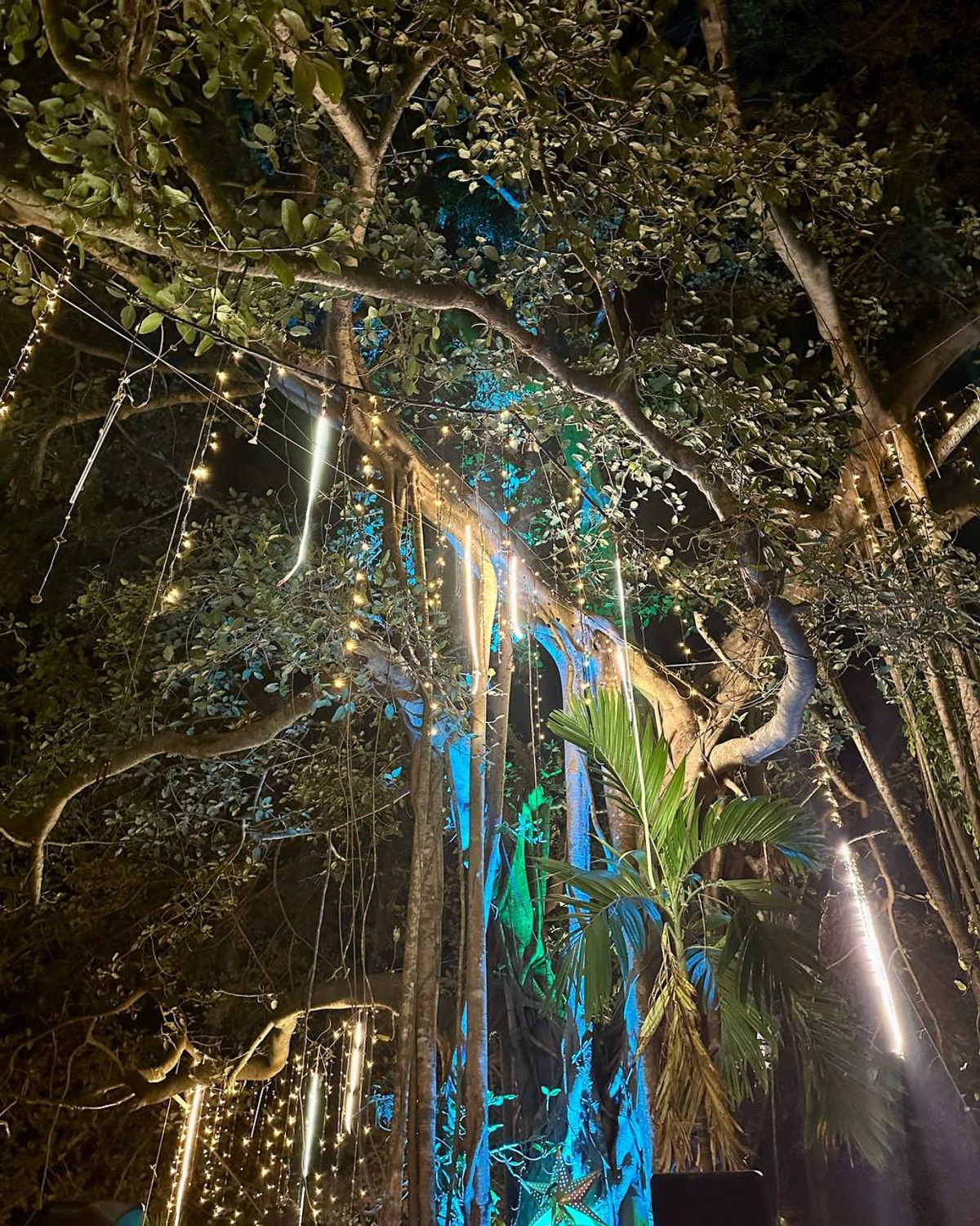
Dodda Aladha Mara in Karnataka covers 12,000 square meters and is approximately 400 years old. The Kabir Vad in Gujarat is over 300 years old and associated with the poet-saint Kabir. Dozens of notable banyans scatter across the subcontinent, each with their own histories and local significance.
Practical Details
If you want to see a significant banyan:
Thimmamma Marrimanu is located about 35 km from Kadiri in Anantapur district, Andhra Pradesh. The Andhra Pradesh Forest Department has implemented protective fencing and dedicated pathways for visitors.
The Great Banyan is in the Acharya Jagadish Chandra Bose Indian Botanic Garden in Shibpur, Howrah, near Kolkata. The garden itself is worth visiting; the banyan draws more visitors than its collection of exotic plants from five continents.
Akshayavat is inside the Allahabad Fort in Prayagraj, Uttar Pradesh. Access has improved in recent years, particularly during Kumbh Mela. The tree is part of the Patalpuri Temple complex.
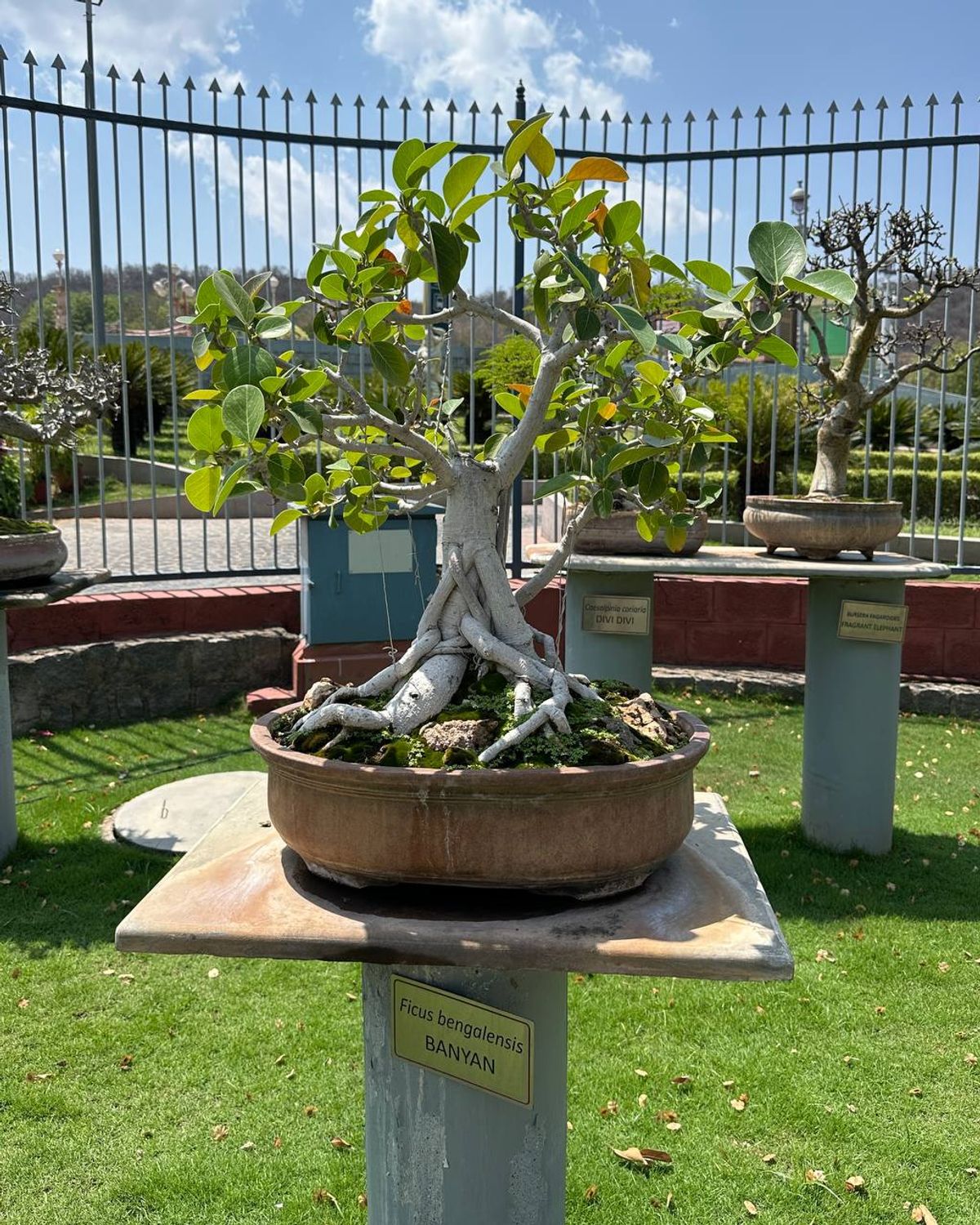
The banyan isn't just India's national tree because it's impressive. It's the national tree because its biology mirrors something the culture values: the idea that what appears to be many can actually be one, that destruction and creation are inseparable, that support can be grown rather than found, that immortality might come not from resisting change but from continuously adapting to it.
One tree. Many trunks. A forest that is also a single organism.
The roots descend. The branches spread. The cycle continues.
The banyan (Ficus benghalensis) is native to the Indian subcontinent and is India's national tree. Notable specimens include Thimmamma Marrimanu (19,107 m² canopy, Guinness World Record holder) and The Great Banyan (18,918 m² canopy). The species is revered in Hinduism, Buddhism, and Jainism.