Everyone knows India as the birthplace of spiritual teachers, yoga and the world's most ancient religions. The climate here seems tailor-made for spiritual practices of any kind. In Indian society, spirituality isn't exotic — it's the norm.
Nearly every resident follows some tradition, incorporating protective rituals and ceremonies into daily life. Politicians consult astrologers before major decisions. Business tycoons build their mansions according to Vastu principles. Even election campaigns are invariably intertwined with religious considerations.
India's educational system reflects this relationship with tradition directly. Universities offer accredited programs in jyotisha (astrology), palmistry, tarot, energy healing and numerology — disciplines with centuries-long pedagogical lineages — and students graduate with state-recognized diplomas.
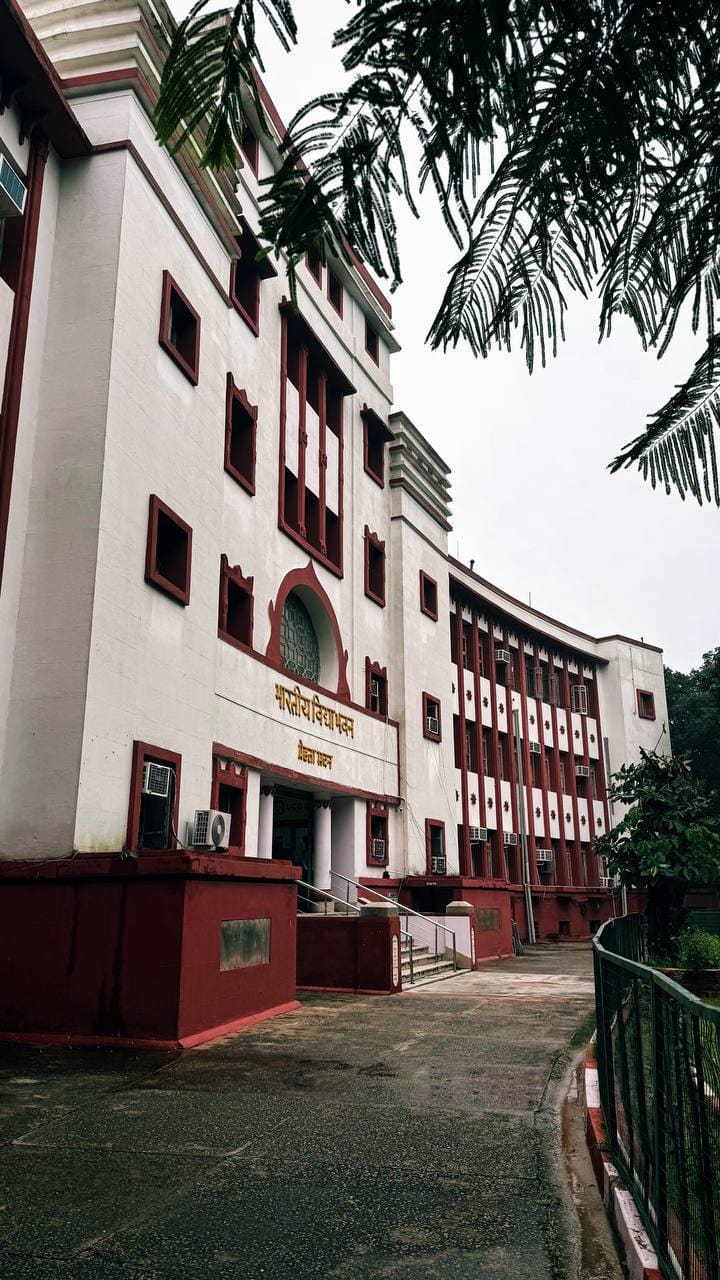
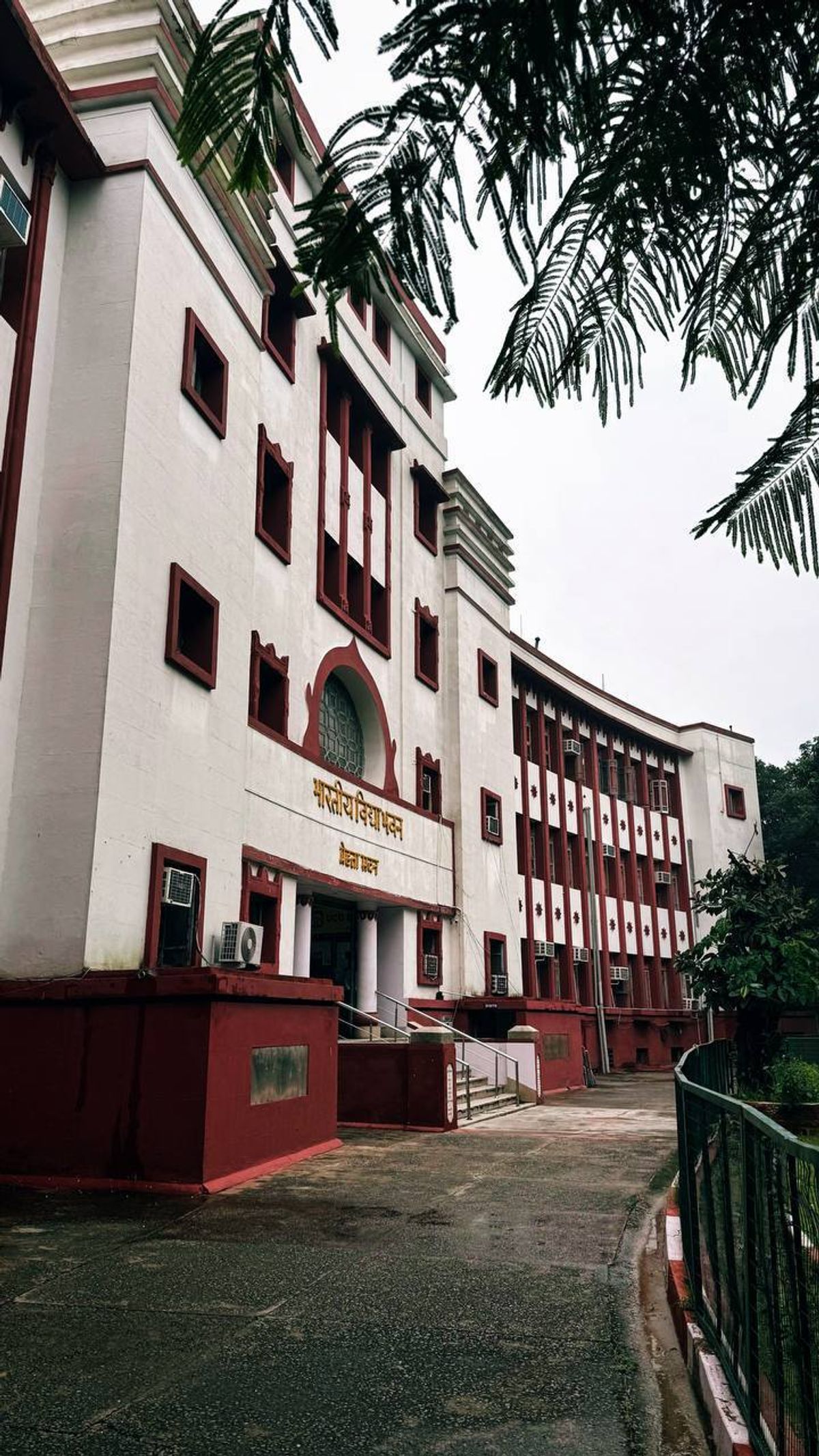
During my recent visit to Delhi, I discovered an institution that embodies this unique fusion of ancient and modern: Bharatiya Vidya Bhavan — literally, "The Indian House of Knowledge."
A Legacy Born From India's Independence Movement
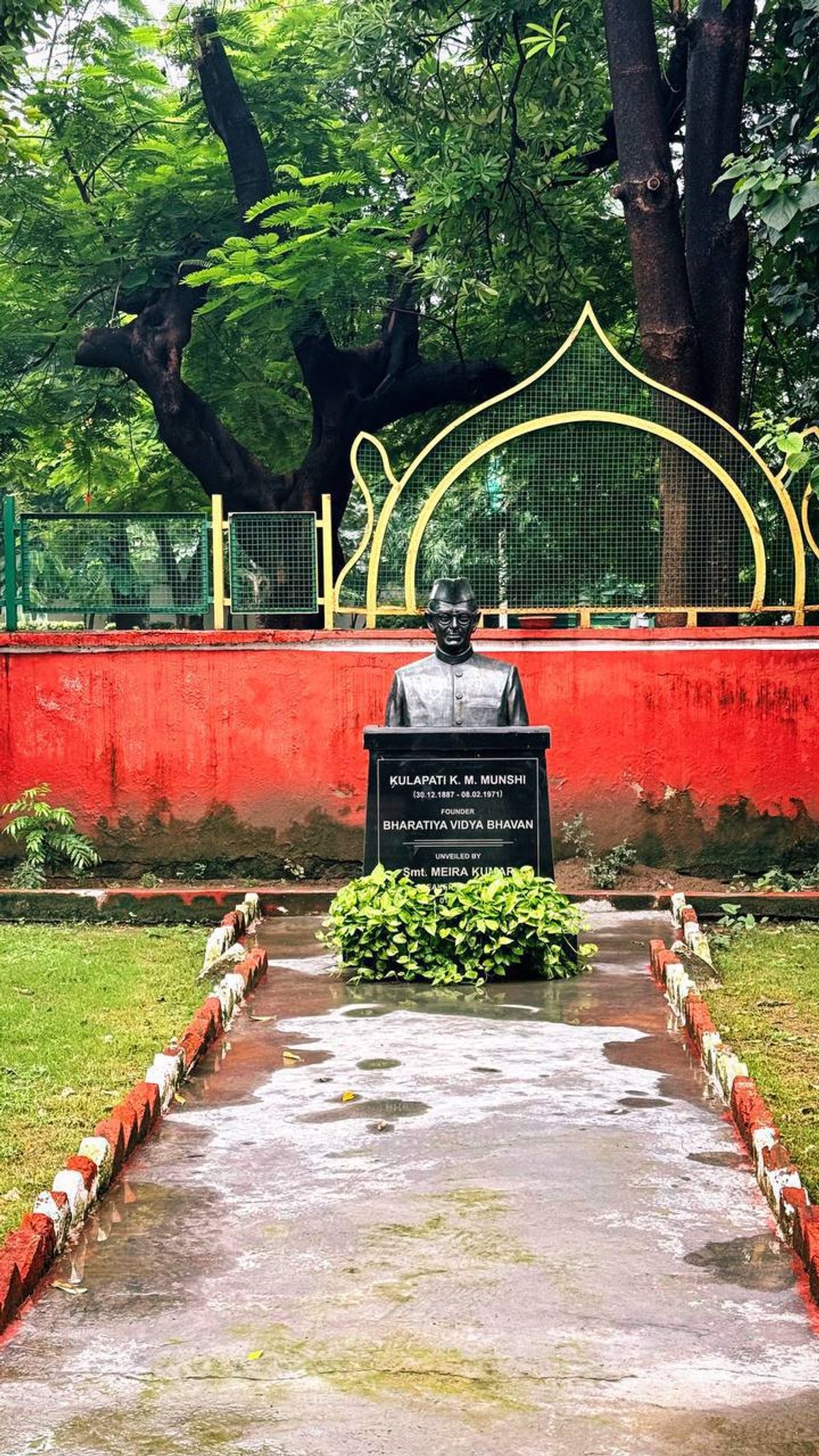
Bharatiya Vidya Bhavan was founded on November 7, 1938 by Kanhaiyalal Maneklal Munshi — a prominent lawyer, politician and freedom fighter who would later play a crucial role in drafting India's Constitution. But what makes this institution particularly remarkable is its co-founder: Mahatma Gandhi himself.
Dr. Rajendra Prasad, India's first President, laid the foundation stone for the Delhi branch in 1952 and inaugurated it in 1957. What began as a modest cultural initiative has evolved into a massive educational network spanning over 100 centers across India and 7 branches abroad. Today, Bharatiya Vidya Bhavan serves more than 200,000 students.
The institution's guiding principle comes from the Rig Veda:
"Aa No Bhadra Kratavo Yantu Vishwatah"
"Let noble thoughts come to us from every side."
This ancient motto perfectly captures the Bhavan's philosophy of intellectual openness — and explains how such seemingly incompatible disciplines can coexist under one roof.
Where Digital Marketing Meets Vedic Astrology
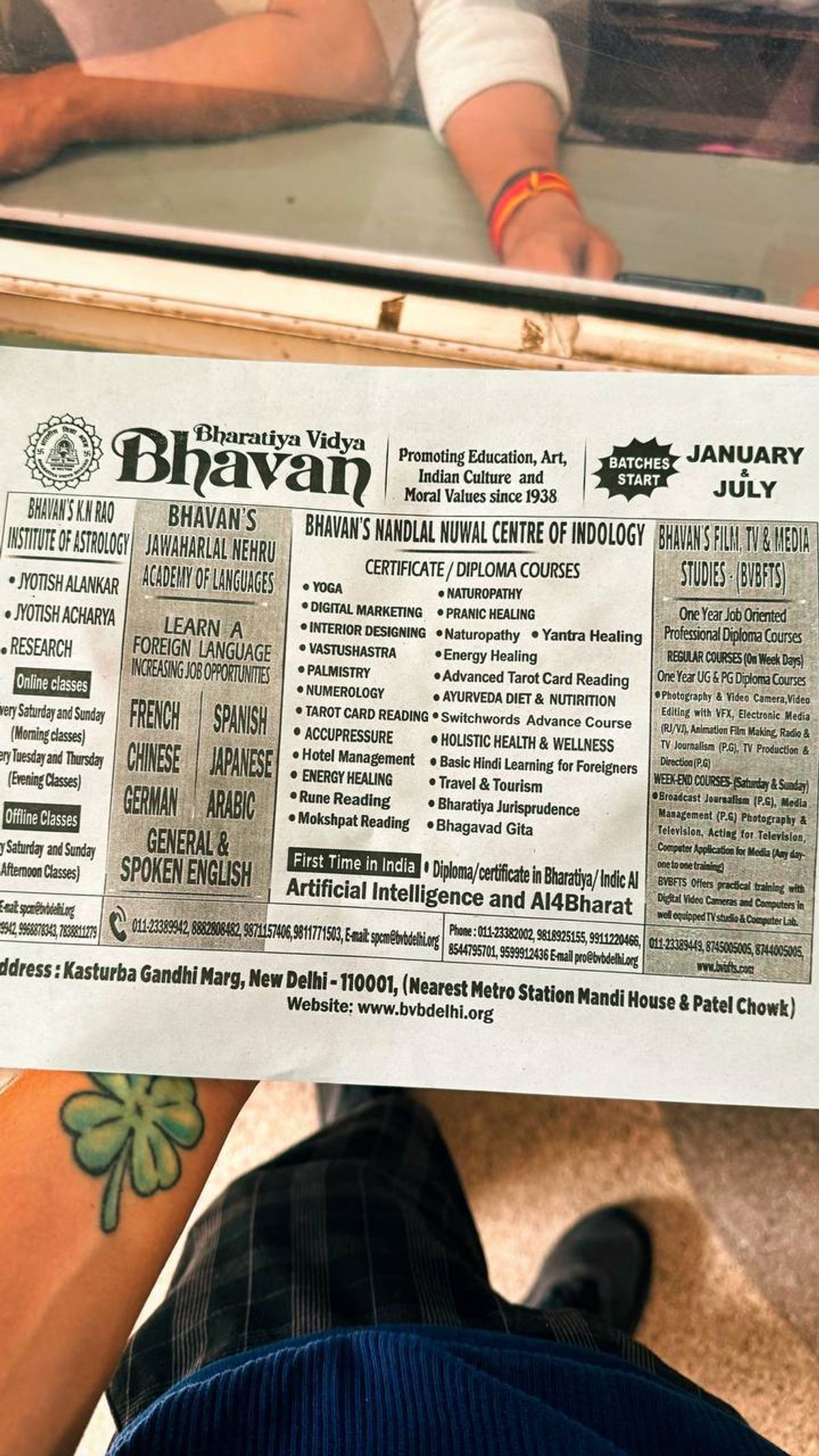
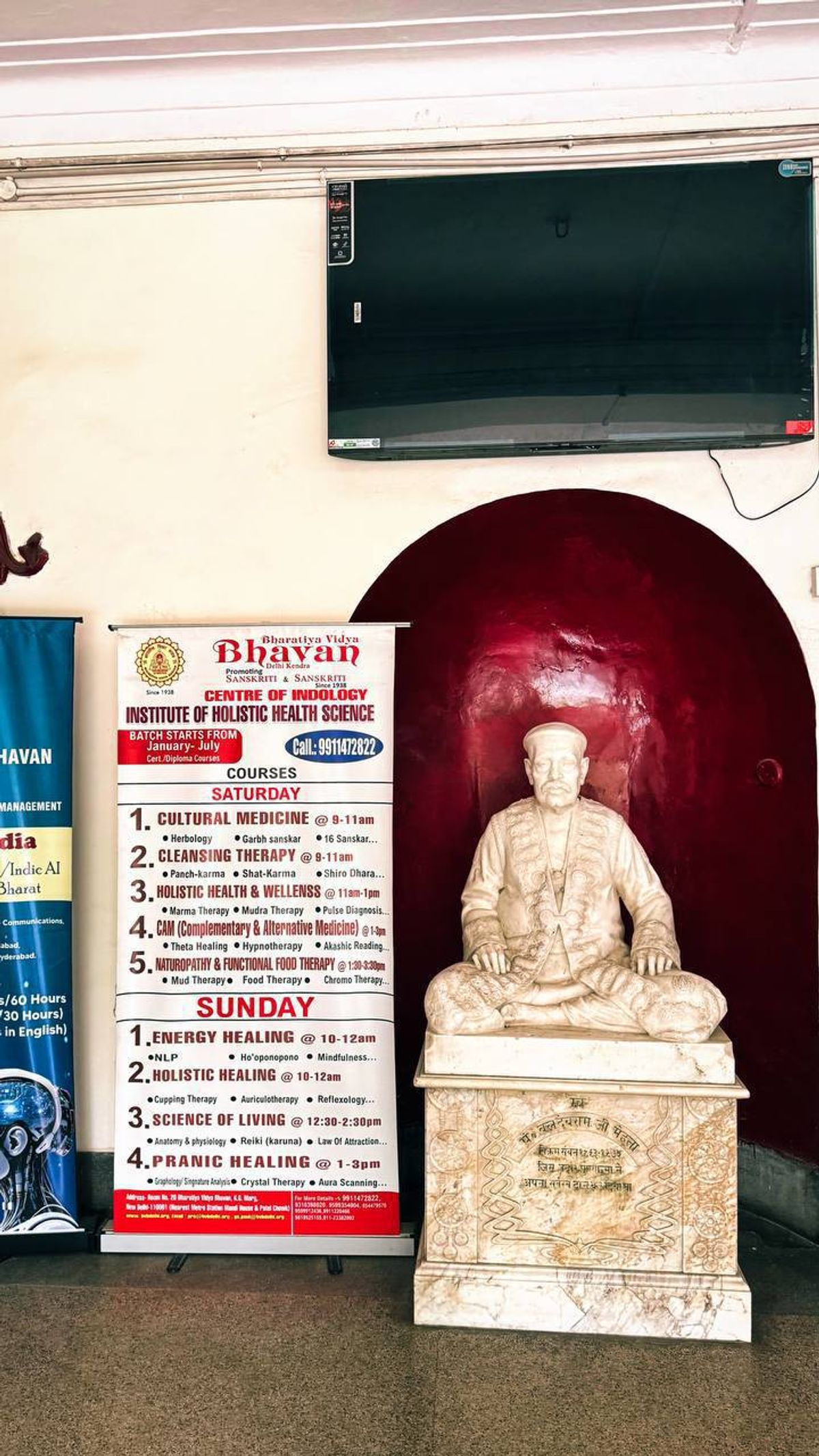
Walking through the Bhavan's corridors in Delhi, I was struck by how naturally the curriculum blends disciplines that would seem contradictory anywhere else in the world. The course catalog reads like a meeting point between Silicon Valley and an ancient ashram:
Technology and Business:
- Artificial Intelligence
- Digital Marketing
- Interior Design
- Hotel and Tourism Management
- IT Courses
Traditional Indian Sciences:
- Vedic Astrology (Jyotish)
- Palmistry
- Numerology
- Vastu Shastra (Indian architectural science)
- Tarot Reading
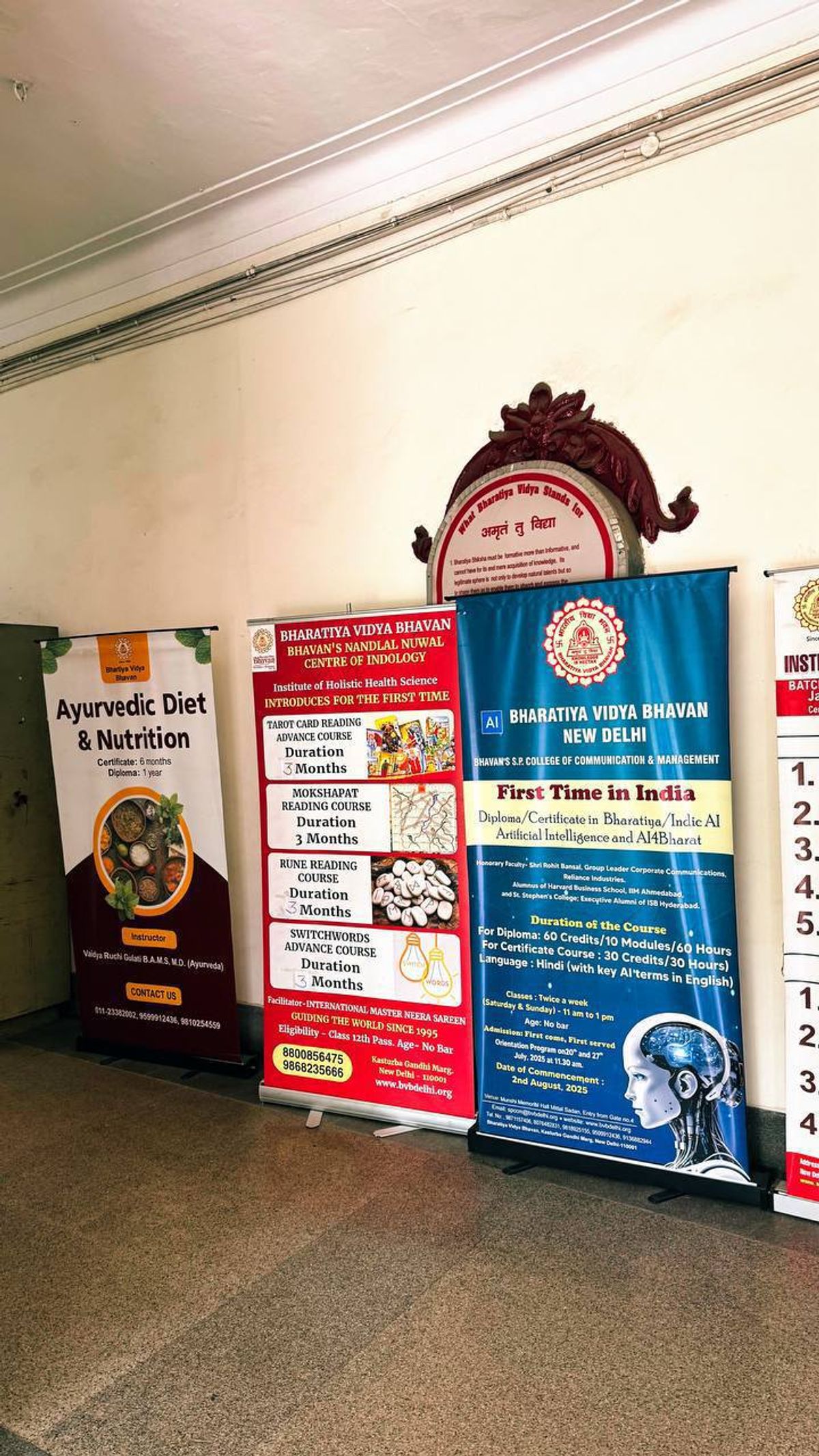
Spiritual and Wellness Studies:
- Yoga (theory and practice)
- Bhagavad Gita Studies
- Prana Healing
- Acupressure and Ayurvedic Nutrition
- Sanskrit
Arts and Culture:
- Kathak Dance
- Classical Vocal Music
- Indology Studies
This isn't about cherry-picking — students can genuinely pursue AI certification while taking palmistry classes, or combine hotel management studies with traditional healing practices. The institution treats all knowledge systems with equal academic rigor.
The Four-Year Bhagavad Gita Program
What caught my attention most was the Bhagavad Gita course. When I asked for details, I learned that classes meet once a week, but the complete program spans four years.
The depth is intentional. According to the course description, "inculcating the Bhagavad Gita takes a long time" — students are expected to continue practicing its principles long after graduation. The program isn't about memorizing verses; it's about transforming how you approach life.
And the cost? Remarkably symbolic: approximately 5,100 rupees for the full program (roughly €55), with discounts for students already enrolled in other Bhavan courses.
The Library: A Time Capsule of Knowledge
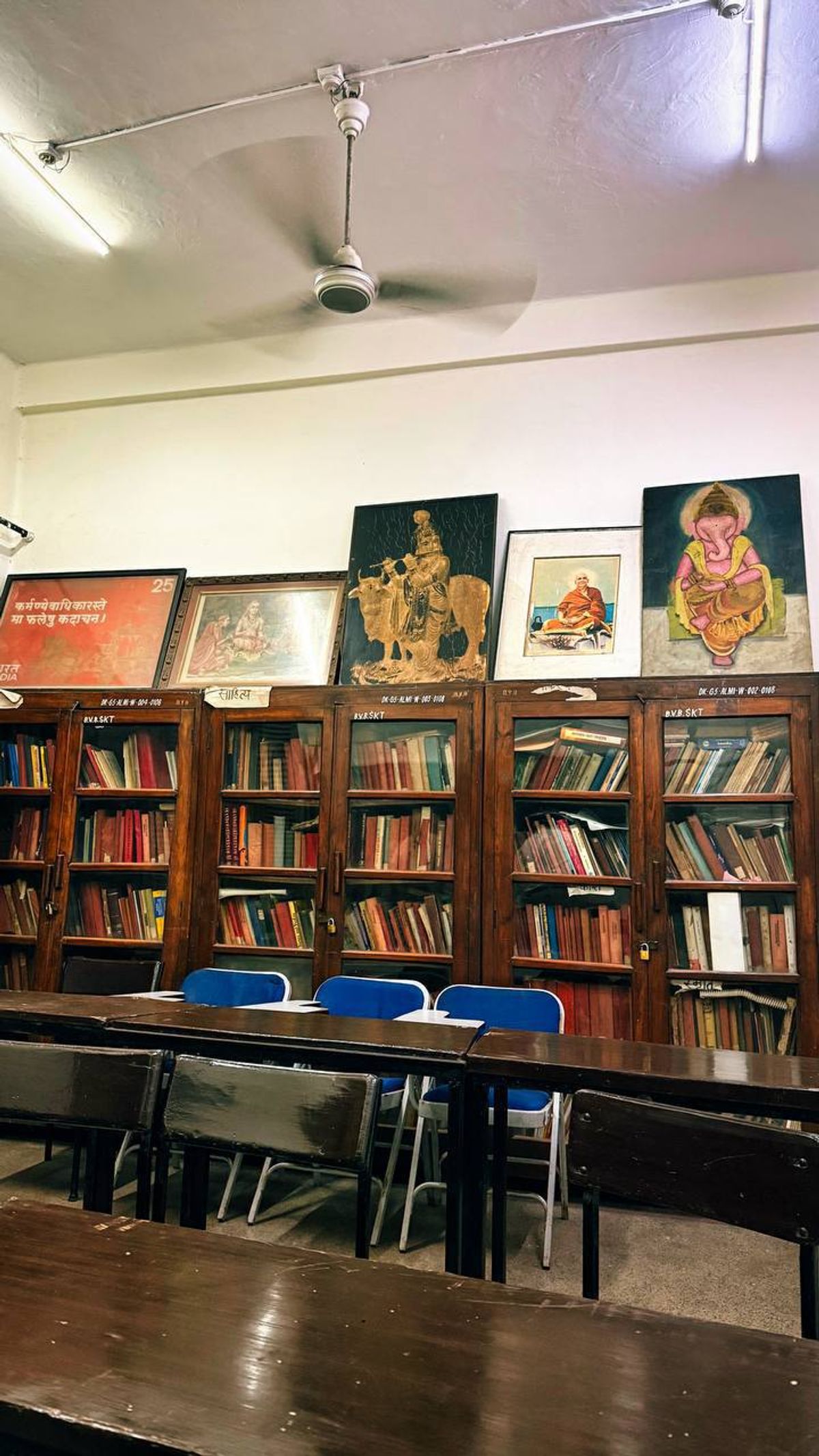
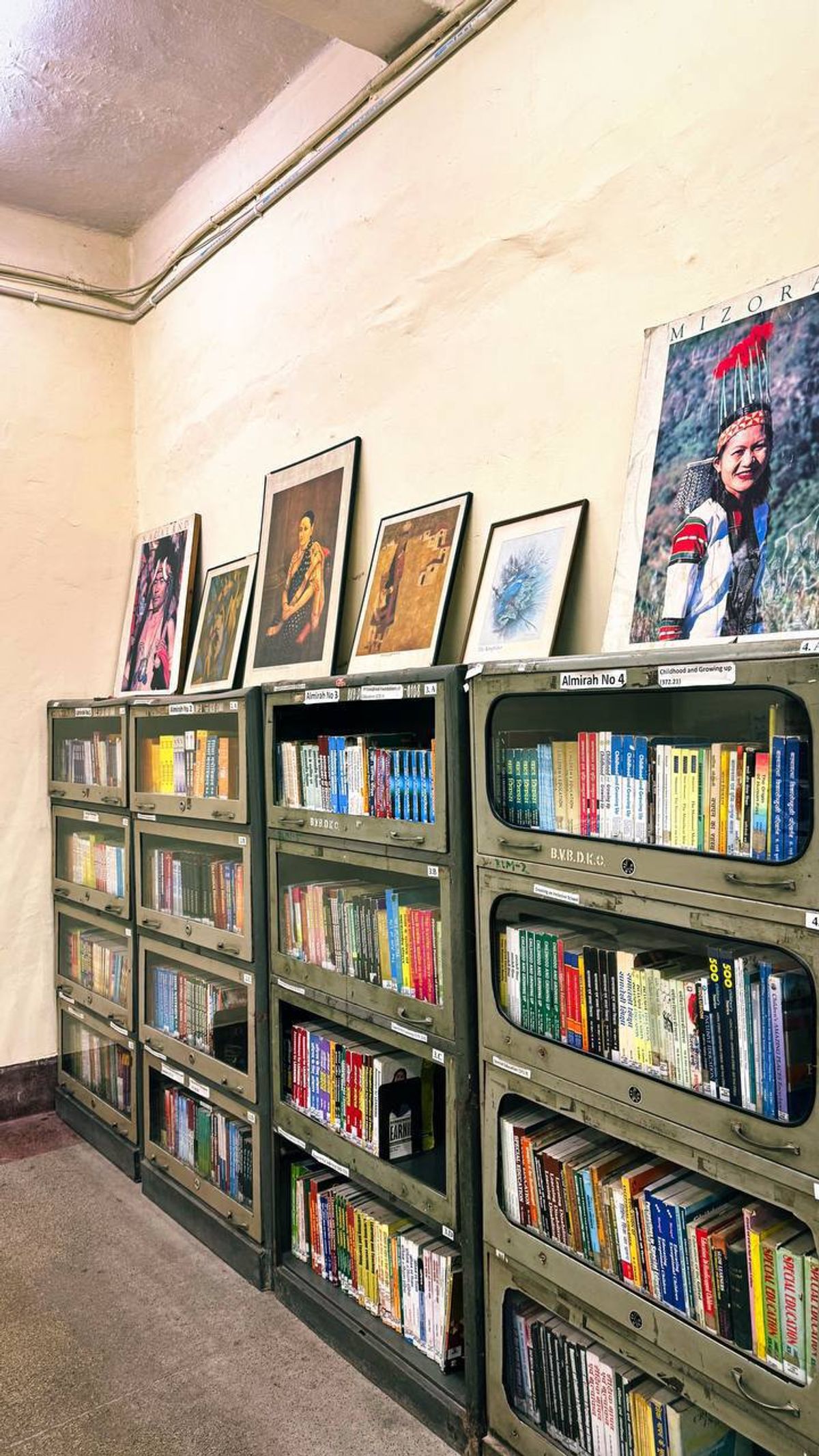
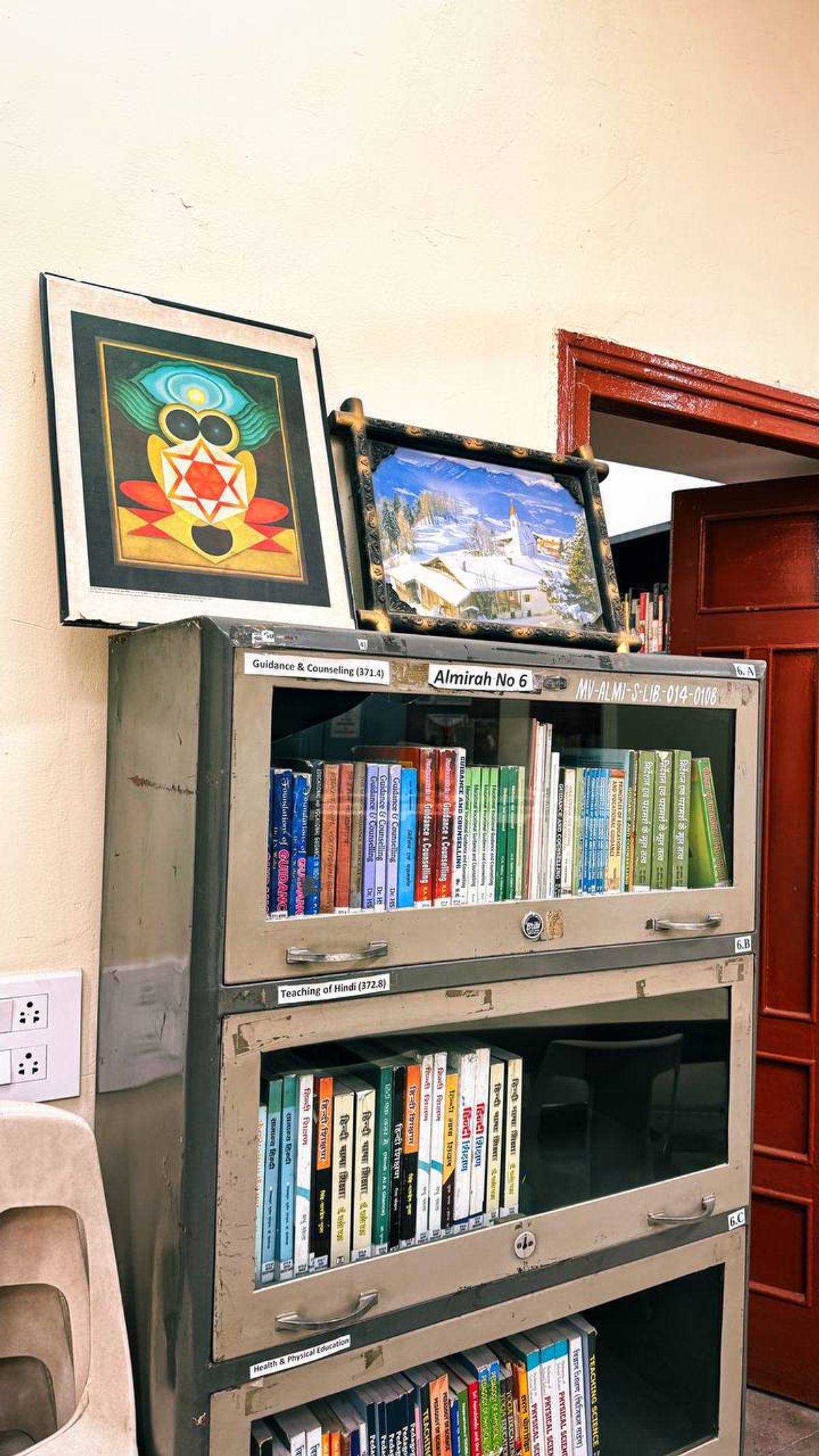
The Bhavan's library is a treasure in itself. Rows of vintage metal cabinets house thousands of books on subjects ranging from Sanskrit grammar to modern computer science. The aesthetic is gloriously unchanged from mid-20th-century India — functional, unpretentious and deeply scholarly.
Gandhi Institute of Computer Education
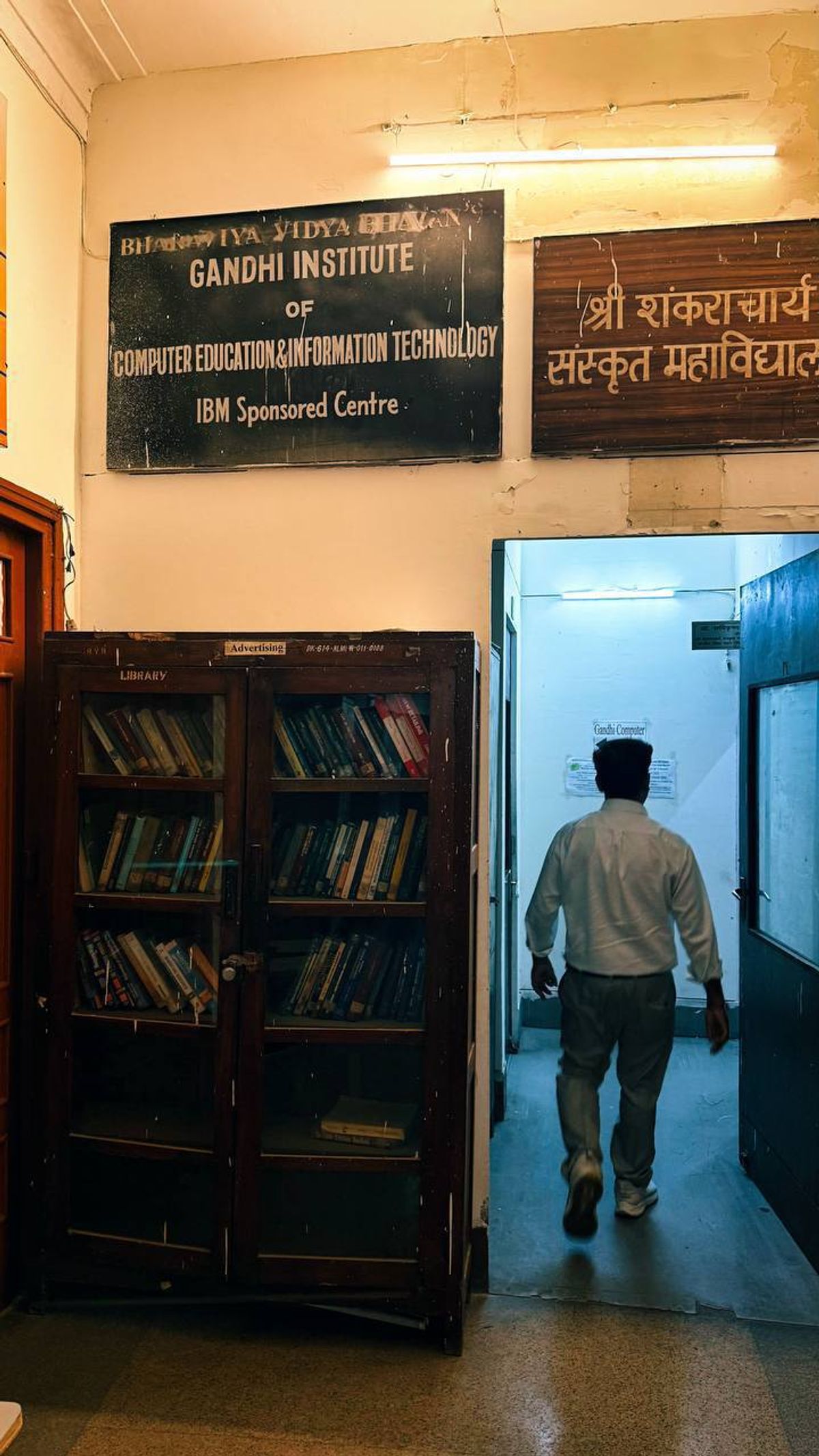
Perhaps the most striking juxtaposition is the Gandhi Institute of Computer Education & Information Technology — an IBM-sponsored center sitting alongside the Sanskrit Mahavidyalaya (Sanskrit college). The signs literally face each other across the hallway.
Online Learning Opens Doors Worldwide
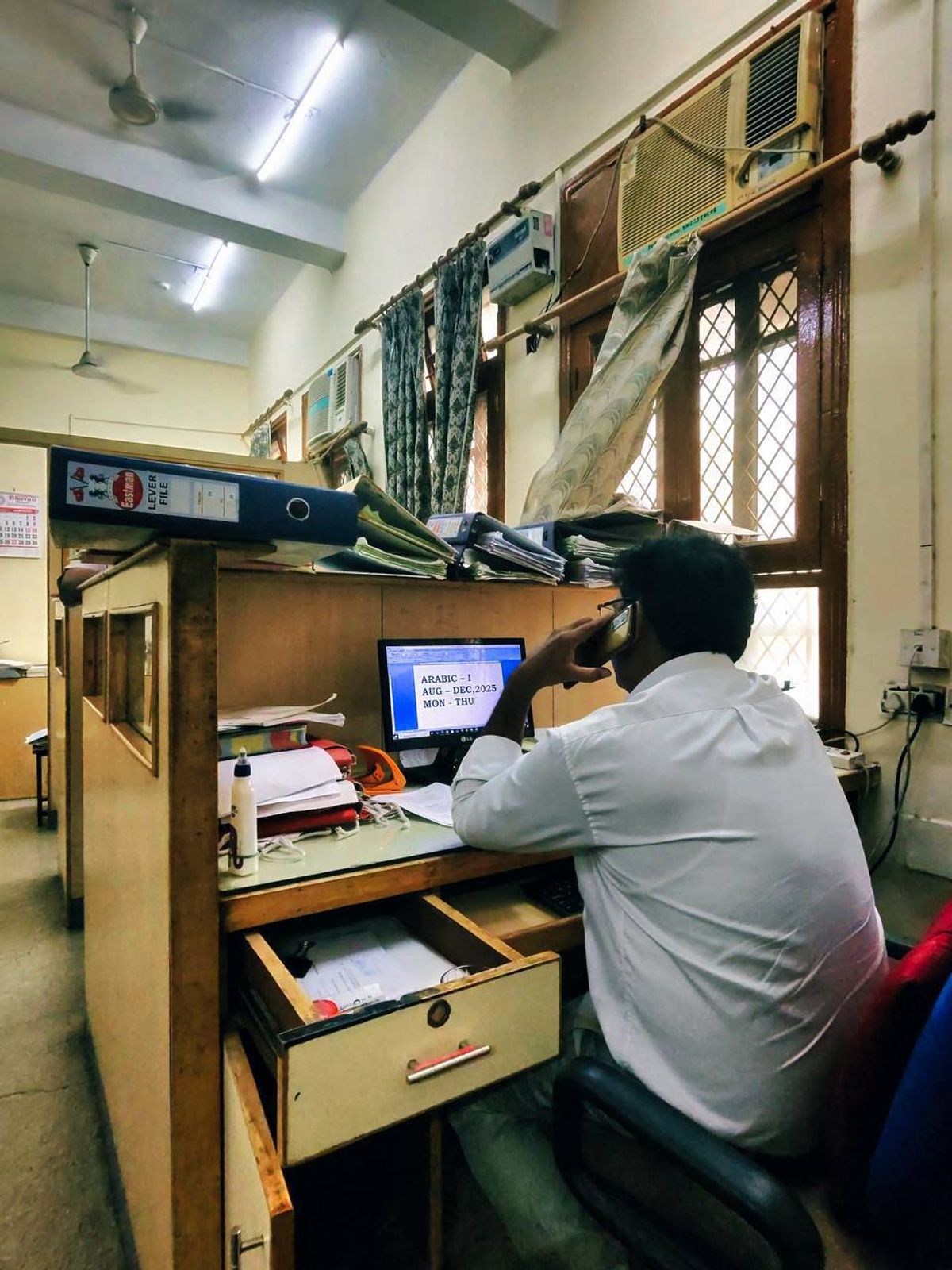
Perhaps the most practical news for international readers: most programs are available online. If you speak English, you can study everything from Vedic astrology to yoga teacher certification without leaving your home country.
The Institute of Astrology, Centre for Indology and Sanskrit Mahavidyalaya all offer distance learning options. This digital accessibility means the Bhavan's unique educational philosophy is no longer limited to those who can physically travel to India.
Why This Matters Beyond India
The Bharatiya Vidya Bhavan represents something increasingly rare in our hyper-specialized world: an institution that refuses to see knowledge as fragmented.
In the West, we tend to draw hard lines between "science" and "spirituality," between "practical skills" and "traditional wisdom." Indian educational philosophy, at least as embodied by the Bhavan, doesn't recognize these divisions. A student can be interested in machine learning algorithms and ancient Sanskrit texts at the same time — and both interests are treated as legitimate pursuits of knowledge.
This approach resonates with a growing global movement questioning whether modern education has become too narrow. Perhaps there's wisdom in an institution that teaches hotel management alongside meditation, or pairs digital marketing with ancient numerical systems.
As the Bhavan's founder K.M. Munshi wrote, India should once again be acknowledged as "vishwa guru" — teacher to the world. Whether or not you agree with that vision, the existence of an institution where AI and astrology share equal academic footing offers a fascinating alternative model for what education could look like.
Practical Information
Bharatiya Vidya Bhavan, Delhi
Website: www.bvbdelhi.org
Address: Kasturba Gandhi Marg, New Delhi – 110001
Contact: +91 011 2338 9942 | info@bvbdelhi.org
Key Programs Available:
- Institute of Astrology
- Centre for Indology
- Yoga Studies
- Sanskrit Mahavidyalaya
- Hotel & Tourism Management
- Bhagavad Gita Studies
- Vastu, Numerology, Palmistry and Tarot
- Artificial Intelligence and Digital Marketing
Most courses offer both in-person and online options. Fees are generally nominal for spiritual disciplines.
Have you encountered unique educational institutions in your travels? Would you consider studying traditional sciences alongside modern technology? Share your thoughts in the comments below.