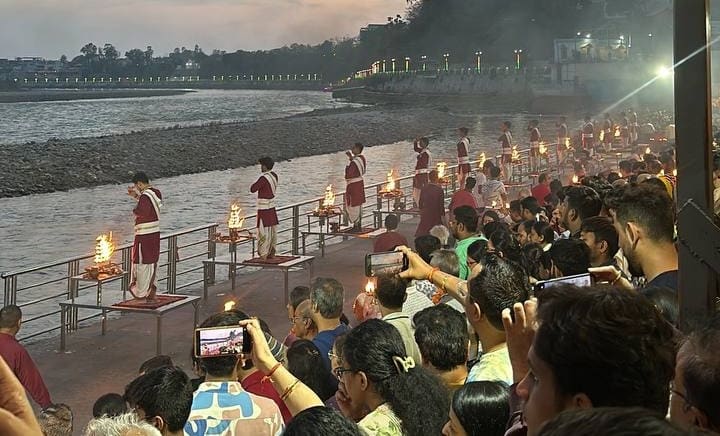
Every evening, as the sun slips behind the Himalayan foothills and the air fills with the scent of incense and the sound of devotional chanting, something extraordinary unfolds at Triveni Ghat in Rishikesh. The city noise fades. Hundreds of people — pilgrims, priests, locals, and travelers — gather on the stone steps leading down to the river. And then, in the golden half-light, the fire begins.
This is Ganga Aarti — one of the oldest and most visually stunning Hindu rituals still performed daily in India. If you visit Rishikesh and see only one thing, let it be this.
What Exactly Is Aarti?
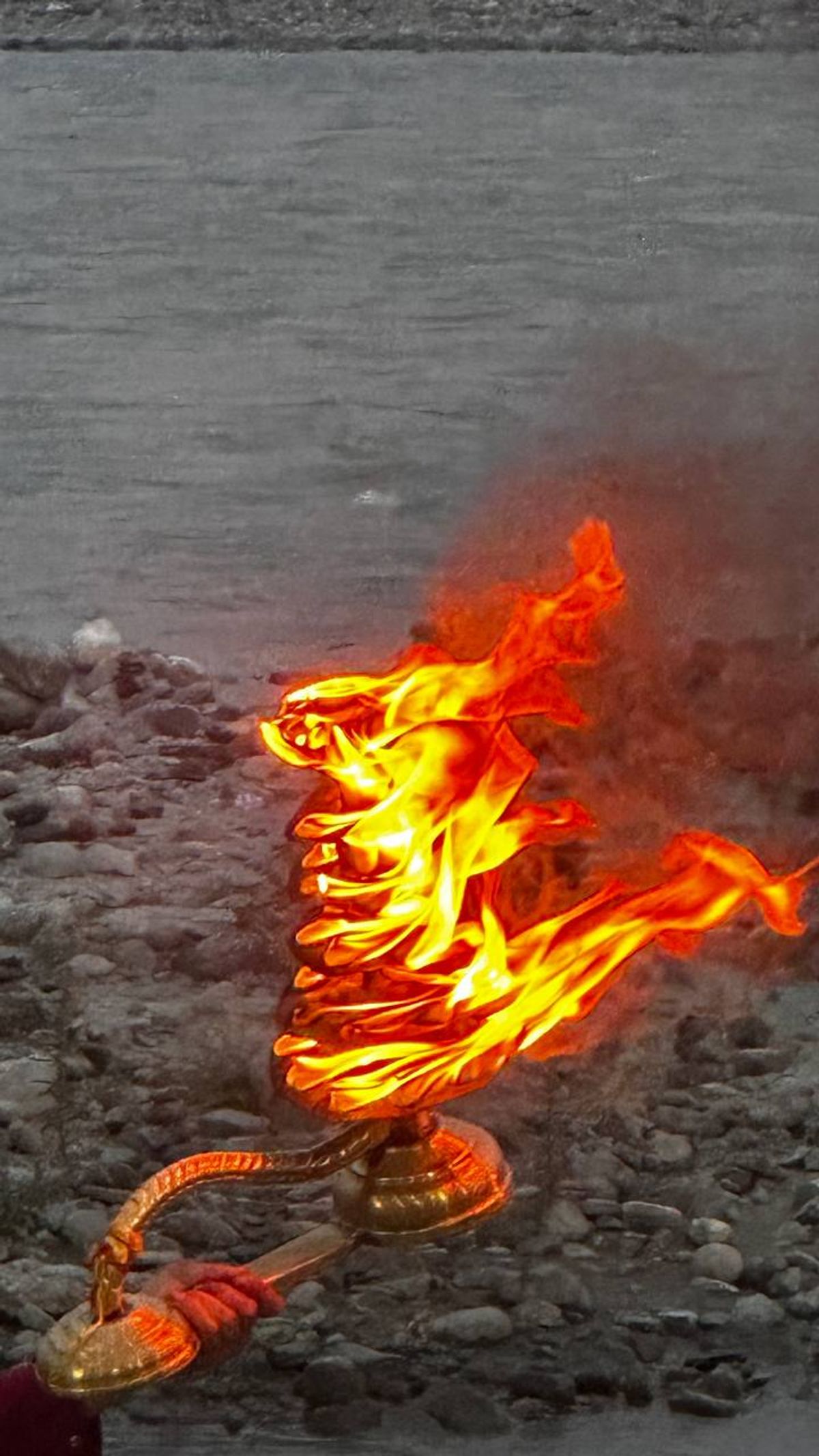
Aarti is a Hindu ceremony of offering fire to the Divine. During the ritual, a priest moves a lit oil lamp (called a dipa) in circular motions before a deity or sacred object — in this case, the river Ganges herself. The flame symbolizes light, love, and devotion, and the circling motion represents the cycle of creation.
But aarti is more than a symbolic gesture. It's a living, breathing prayer. The fire illuminates the face of the divine image (murti), and in that moment the devotee is said to receive darshan — a sacred instant in which you see God, and God sees you.
The Ganges is not treated as a mere river in Hinduism. She is a goddess — Ganga Maa (Mother Ganga) — revered as a purifier of body and soul. That's why on her banks, every morning and every evening, this ancient tradition is performed with deep reverence and joy.
Ganga Aarti at Triveni Ghat: What to Expect
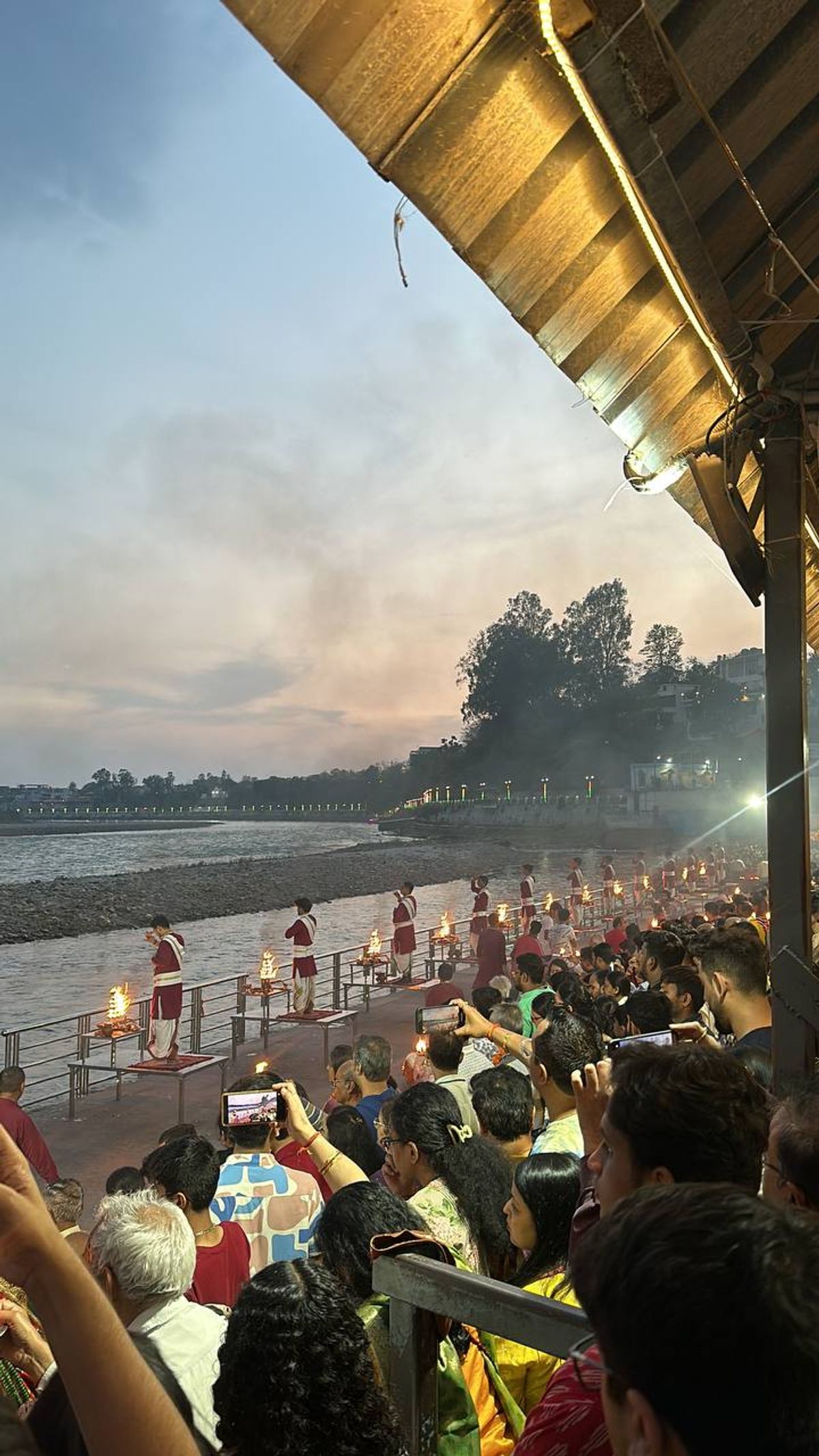
Triveni Ghat is the main venue for the evening aarti ceremony in Rishikesh. It sits in the central part of the city, about 10–15 minutes by rickshaw from the popular Tapovan neighborhood.
The ceremony begins around sunset — roughly 5:00–6:00 PM depending on the season. People start arriving early: pilgrims, pandits (priests), locals, and tourists slowly fill the open area and the hall beside the ghat. Devotional songs called bhajans echo through the space, and many people sing along, creating an atmosphere that feels almost mystical before the ceremony even begins.
Then 14 priests in saffron robes line up along the riverbank. They raise large brass lamps filled with fire above the water. In that instant, the space transforms. Tongues of flame, mantras, ringing bells, clouds of incense smoke — everything falls into a single rhythm. The fire moves in circles, like a prayer that has taken the form of a dance.
After the main ritual, everyone is invited to "receive the fire" — you pass your hands over the flame and then touch your forehead. It's considered a gesture of purification and blessing. And then comes the most unexpected and alive part of the evening: the kirtan. Mantras turn into songs. People stand, sing, dance, and laugh. The spontaneous joy feels like an eruption of pure energy.
As the ceremony winds down, many release small offerings into the river — little leaf boats carrying flowers and a burning candle. Each one holds its own prayer, a request, a note of gratitude, drifting quietly downstream into the darkness.
Insider tip: At the entrance to the ghat, try bhel puri — a popular Indian street snack that combines crispy puffed rice, spice, sweetness, and freshness. I've tried it across India, and the one here was the best I've had.
Why Rishikesh Aarti Feels Different
If you've been to Varanasi's dramatic Dashashwamedh Ghat ceremony — with its seven synchronized Brahmins, booming conch shells, and hundreds of boats gathered on the river — or to Haridwar's massive ritual at Har Ki Pauri, where thousands of people crowd the steps and the entire river surface glows with floating lamps, you might wonder: how is Rishikesh any different?
The answer is in the feeling.
In Varanasi, aarti is spectacle. It's overwhelming, cinematic, almost theatrical. The crowd is enormous, the energy intense, everything plays out on a grand scale. You can watch from a rented boat for 100–200 rupees — honestly, it's the best angle and spares you the crush of bodies on the steps.
In Haridwar, the aarti at Har Ki Pauri is raw and powerful — the bare nerve of Hindu devotion. Thousands of people press together, there's barely room to breathe, and the collective energy is overwhelming. The atmosphere is less about personal experience and more about being swept up in something far bigger than yourself.
Rishikesh is neither. It's quieter, more intimate, and — for many travelers — more personal. The scale is smaller. The crowd is gentler. There's space to sit, to breathe, to actually feel what's happening rather than just watch it. The mountains cradle the scene, the river runs clearer here (close to its Himalayan source), and the post-aarti kirtan feels like a spontaneous celebration rather than a produced event.
If Varanasi's aarti is a symphony, and Haridwar's is a thunderstorm, then Rishikesh's is a candlelit conversation with the sacred.
Where Else Can You See Ganga Aarti in India?
The most spectacular Ganga Aarti ceremonies take place in four cities along the Ganges:
- Rishikesh — intimate, spiritual, set against Himalayan foothills. Best for those seeking a personal, meditative experience. The ceremony at Triveni Ghat includes 14 priests and often ends with an energetic kirtan.
- Varanasi — the most famous aarti in India, held nightly at Dashashwamedh Ghat. Seven young Brahmins perform synchronized rituals with fire, incense, and mantras before massive crowds. This is India's oldest continuously inhabited city, and the ceremony carries thousands of years of unbroken tradition.
- Haridwar — held at Har Ki Pauri ("Footsteps of the Lord"), one of the holiest ghats in India. The ceremony here is massive — thousands of worshippers, dozens of priests, hundreds of flames. The entire river surface glows with floating diyas. More crowded and intense than Rishikesh, but undeniably powerful.
- Prayagraj (Allahabad) — at the sacred confluence (Sangam) of the Ganges, the Yamuna, and the mythical Saraswati. Less touristy, deeply devotional.
Understanding the Ritual: A Glossary for First-Time Visitors
If you're new to Hindu ceremonies, here are the key terms you'll encounter:
- Aarti
- A fire-offering ritual expressing gratitude and devotion. A priest rotates a lit lamp before a deity while mantras are chanted and bells ring.
- Ghat
- Stone steps leading down to a river, used for bathing, rituals, and ceremonies.
- Murti
- A sacred image or form of a deity, through which God is worshipped.
- Darshan
- The act of "seeing" the divine. In the moment of darshan, you see God and God sees you.
- Bhajan
- Devotional songs, often sung as a group before or during aarti.
- Kirtan
- Collective chanting of divine names in a call-and-response format, often accompanied by music, clapping, and dancing.
- Dipa (Deepa)
- The oil lamp used during aarti, symbolizing the removal of darkness and ignorance.
- Prashad (Prasad)
- Blessed food that has been offered to God and then distributed to devotees.
Practical Tips for Attending Ganga Aarti in Rishikesh
When to go: The ceremony takes place every evening, year-round. Arrive at least 30–40 minutes before sunset to get a good spot. The exact time shifts with the seasons — roughly 5:00 PM in winter and 6:00–6:30 PM in summer.
What to wear: Dress modestly. Cover your shoulders and knees. Remove your shoes before stepping onto the ghat near the water.
Etiquette: Be respectful during the ceremony. Keep your phone on silent. You can take photos and videos, but avoid using flash and try not to obstruct others' views.
How to participate: You don't need to be Hindu to attend. Sit quietly, observe, and soak it in. After the main ceremony, you can approach the flame to receive a blessing. You can also buy a small leaf boat with a candle (around 10–20 rupees) and release it into the river with your own intention or prayer.
Getting there: Triveni Ghat is in the central part of Rishikesh, near the Swarg Ashram / Muni-ki-Reti area. From Tapovan (a popular area for yoga schools and cafés), it's about a 10–15 minute rickshaw ride or 20–25 minutes on foot.
After the ceremony: Walk through Triveni Market, right next to the ghat — a lively bazaar where you can find traditional kurtas, saris, prayer accessories, and other items. It's a great way to extend the evening.
Beyond Aarti: What Makes Rishikesh Special
Rishikesh is more than a place to watch a ceremony. The city's name comes from Hrishikesha — one of the names of Lord Vishnu, meaning "Master of the Senses." According to legend, the great sage Raibhya performed intense ascetic practices here, and Vishnu himself appeared before him, blessing this land as sacred.
For centuries, rishis (sages) and yogis have meditated on the banks of the Ganges here. In the West, Rishikesh became famous in 1968, when The Beatles traveled here to study transcendental meditation with Maharishi Mahesh Yogi — a visit that played a significant role in popularizing yoga and Eastern philosophy worldwide.
Today, Rishikesh is a living ecosystem of ashrams, yoga schools, cafés, and spiritual communities. The Tapovan neighborhood buzzes with vegan cafés, bookshops stocked with Vedic texts, and people in yoga pants discussing mindfulness over chai. The area around Lakshman Jhula and Ram Jhula bridges pulses with energy — markets, street food, sacred cows, incense, and mantras all mixed together in one living organism.
But the real magic of Rishikesh reveals itself when you step beyond the center — toward the mountains, the hidden waterfalls, the quiet villages, and the ancient temples that most visitors never see.
And it all starts with that first evening at Triveni Ghat, when the fire rises over the water and something inside you gets very, very quiet.