There's a particular kind of denial that kicks in when your body starts to fail in a foreign country. You tell yourself it's a cold. You tell yourself it's the air conditioning. You tell yourself you'll be fine by morning, because you have two conferences booked — one in Chandigarh, one in Dubai — and there's no room in the schedule for being seriously ill.
I was wrong. What I thought was a garden-variety bug turned out to be dengue fever — one of the most common and most unpleasant diseases a traveler can pick up in India and the tropics. This is the story of what happened, what I learned, and everything I wish someone had told me before that first mysterious temperature spike.
The First Lie You Tell Yourself
It started the way these things always start: innocently. A vague feeling of weakness. A temperature. Nothing dramatic — just enough to reach for the medicine cabinet.
I did what I'd always done with tropical bugs — I started popping azithromycin, my old reliable antibiotic that had bailed me out of every previous illness in India. For a few hours at a time it seemed to work, or at least I convinced myself it did.
But this time was different. The usual symptoms weren't showing up. No runny nose. No cough. No sore throat. Just a high fever that wouldn't quit, a deep ache in every muscle, and a heaviness in my head that felt like my skull had been filled with wet concrete.
In India, there's a widely known rule that every long-term resident picks up eventually: if a fever holds for three days without obvious cold or flu symptoms, get a blood test for dengue and malaria. No exceptions. No "let me just wait one more day." Three days, blood test, done.
I ordered a home test through the 1mg app — one of India's most popular health platforms that sends a phlebotomist to your door. The result came back the same day: dengue positive.
The conferences were cancelled.
What Dengue Actually Feels Like
The medical literature will tell you that dengue typically presents with a temperature of 39–40 °C, myalgia, arthralgia, headache, and fatigue, with symptoms lasting two to seven days and most patients recovering in one to two weeks. What the medical literature doesn't quite capture is the existential quality of the exhaustion.
For six days my temperature hovered around 40 °C. Paracetamol would bring it down for a few hours — exactly as long as the pill lasted — and then the fever would return like clockwork. It felt less like being sick and more like being aged fifty years overnight. Walking to the kitchen became a genuine physical challenge. My brain ran at roughly the speed of a dial-up modem from 1998. Reading a paragraph took the kind of concentration I normally reserve for tax returns.
Then the fever broke and a new phase began: the weakness. Even ten days in, I was still recovering. The body doesn't just bounce back from dengue — it crawls back, slowly, grudgingly, as if it hasn't quite decided whether to forgive you.
The Science Behind Why Dengue Hits So Hard
To understand why dengue is so debilitating, it helps to know what's happening inside your body. Dengue is caused by the dengue virus (DENV), which belongs to the flavivirus family and is transmitted through the bite of infected Aedes aegypti mosquitoes — the same elegant little vampires responsible for Zika, chikungunya, and yellow fever.
Once it enters the bloodstream, the virus doesn't just attack one system — it wages a multi-front war. It directly infects bone marrow cells, the factory where your body produces platelets, the tiny cell fragments responsible for blood clotting. At the same time, your immune system launches antibodies that, in an unfortunate case of friendly fire, sometimes attack your own platelets instead of the virus. The result is thrombocytopenia: a dramatic drop in platelet count that can push the body into dangerous territory.
A healthy adult has between 150,000 and 450,000 platelets per microliter of blood. During dengue, that number can plummet below 50,000 — and in severe cases, below 20,000 or even 10,000, which is when doctors start talking about transfusions and hospitalization. According to clinical studies, platelet counts typically hit their lowest point around day six of the illness and begin recovering around day nine, though the timeline varies depending on severity and individual health.
The virus also attacks the liver, which is why medical guidelines are emphatic about avoiding ibuprofen, aspirin, and alcohol during infection — all of which stress an organ that's already under siege.
I was fortunate. My platelet counts dropped but stayed above the critical threshold, and within two weeks my blood work was back to normal. Not everyone is that lucky.
What I Actually Did (and What Doctors Recommended)
I want to be clear: I'm not a doctor. What follows is my personal experience and the advice I received from medical professionals during my illness. If you suspect you have dengue, get professional medical attention — not a blog post.
That said, here's what worked for me and what was recommended by the specialists I consulted:
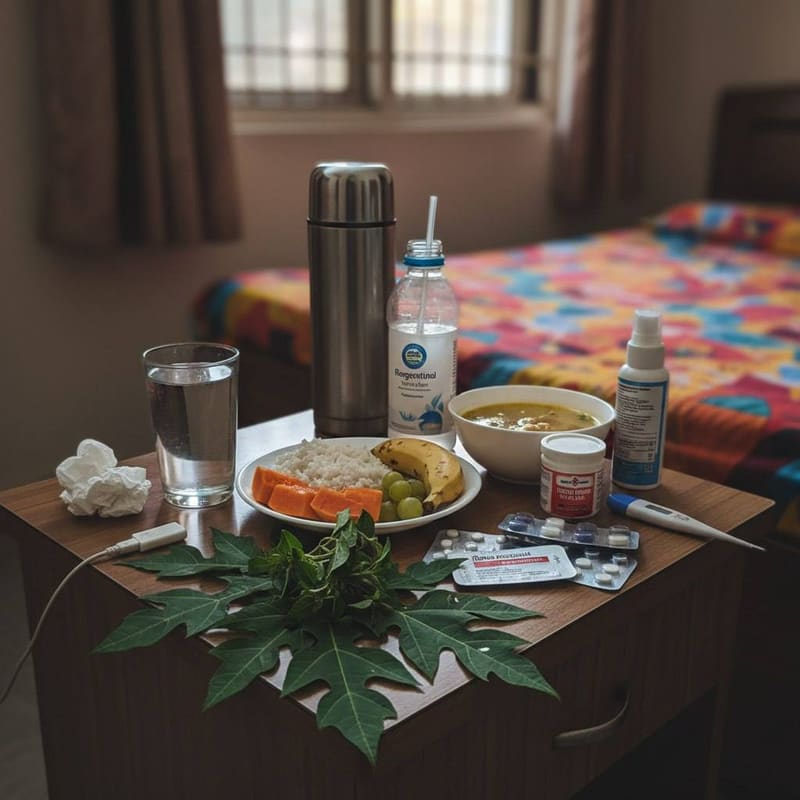
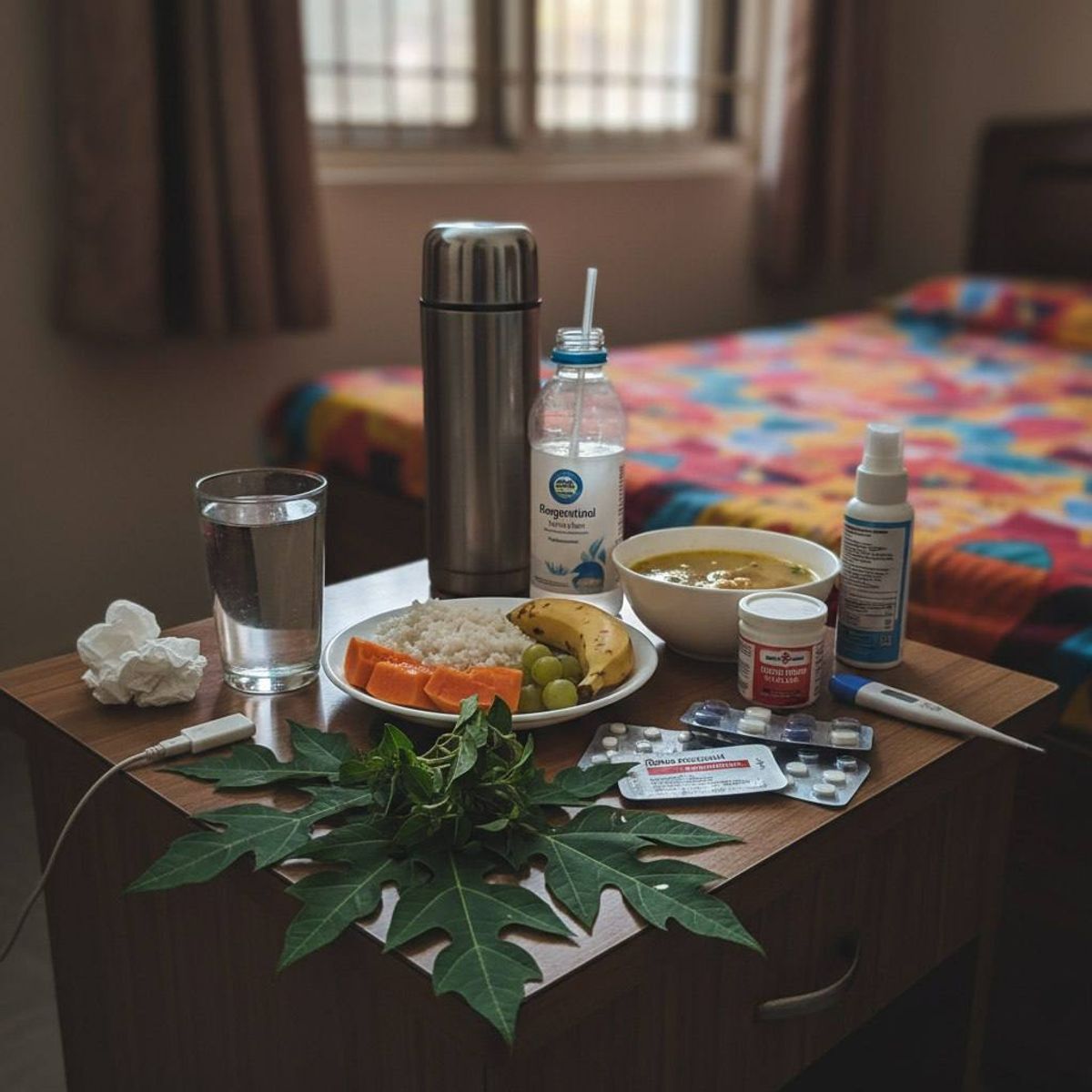
Papaya leaf extract and tulsi (holy basil). This is one of the most well-known traditional Indian remedies for dengue, and it's not just folk wisdom — there are studies supporting papaya leaf's role in helping restore platelet counts. You can brew a tea from fresh leaves or buy capsules at any Indian pharmacy. Tulsi supports liver function and immune response, both of which take a beating during dengue. I took both daily throughout my illness.
Aggressive hydration with ORS. Dehydration is the single biggest danger during dengue — more dangerous, in most cases, than the low platelet count itself. I drank enormous quantities of water, coconut water, light broths, and herbal teas, topped up with ORS (oral rehydration salts), which are available at literally every pharmacy in India for a few rupees. ORS replaces the electrolytes the body burns through with every fever spike and helps prevent the dizziness, weakness, and dangerously low blood pressure that dehydration brings.
Complete avoidance of liver-stressing substances. No ibuprofen (only paracetamol for pain and fever). No alcohol. No coffee. No heavy, greasy food. My diet during recovery was aggressively simple: rice porridge, clear soups, fresh fruits, and light dals. The goal was to give my liver nothing extra to process while it was already fighting the virus.
Rest — real rest, not "working from bed" rest. Even after the fever broke, I resisted the urge to jump back into life. The body is profoundly weakened after dengue, and pushing too hard too early can cause a relapse. I gave myself a full ten to fourteen days of genuine rest before returning to any work or travel.
Patience. Perhaps the hardest prescription of all. Dengue is not a fast illness. It exhausts you at a cellular level, and recovery is measured in weeks, not days. The temptation to declare yourself "fine" and get back to normal is strong. Don't trust it. Listen to your body, not your calendar.
The Numbers: Dengue in India and the Tropics
If you're traveling to India or any tropical country, dengue is not an abstract risk — it's a statistically significant one.
In 2024 alone India reported over 230,000 dengue cases and 236 deaths; by October 2025, more than 91,000 cases had been recorded. Globally, 2024 was the worst year for dengue ever documented — the WHO received reports of more than 14 million cases and 11,200 deaths worldwide. The virus is now actively transmitted in over 100 countries, and researchers expect that trend to continue as climate change expands the range of the Aedes mosquito.
In India, dengue peaks during and immediately after the monsoon season (June through November), when standing water creates ideal breeding grounds for mosquitoes. The highest-risk states historically include Tamil Nadu, Karnataka, Kerala, Uttar Pradesh, West Bengal, and Rajasthan — but dengue has been reported in virtually every state.
Here's the critical context for travelers: symptoms typically appear four to ten days after a mosquito bite. This means you can be bitten in India, fly home, and develop dengue in a country where doctors may not immediately think to test for it. If you develop an unexplained high fever within two weeks of returning from a tropical country, tell your doctor where you've been.
Prevention: What Actually Works
There is currently no widely available dengue vaccine for travelers, though India plans to roll out Takeda's QDENGA vaccine in 2026 under its "Make in India" initiative. Until then, prevention is entirely about avoiding mosquito bites — which sounds simple but takes consistent discipline.
Repellent is non-negotiable. Apply DEET-based or picaridin-based repellent to all exposed skin, especially during dawn and dusk when Aedes mosquitoes are most active. Reapply after sweating or swimming. In India, you can buy effective repellents like Odomos at any general store for a few rupees.
Cover up during peak hours. Long sleeves and long pants at dawn and dusk. Yes, even when it's hot. The mosquitoes that carry dengue are daytime biters, unlike malaria mosquitoes that feed at night — a distinction many travelers don't know.
Eliminate standing water. If you're staying in a long-term rental, check for standing water in flower pots, AC units, buckets, and roof gutters. Aedes aegypti can breed in a bottle cap's worth of water.
Use a fan or AC. Mosquitoes are weak fliers. A ceiling fan or air conditioning unit creates enough air movement to keep them at bay.
Mosquito coils and electric vaporizers. Good Knight and All Out are the most common brands in India. Plug-in vaporizers work all night and are effective in enclosed rooms.
Don't rely solely on mosquito nets. Since dengue mosquitoes bite during the day, a bed net only helps while you're sleeping. During waking hours, repellent and physical barriers are your primary defense.
The Three-Day Rule
If there's one thing I want every traveler to India to remember from this article, it's the three-day rule.
If you develop a fever that lasts three days without clear cold or flu symptoms, get a blood test for dengue and malaria. Don't wait. Don't self-medicate with antibiotics. Don't assume it'll pass.
In Indian cities, you can order a home blood test through apps like 1mg, Practo, or PharmEasy — a phlebotomist will come to your door, draw blood, and send results to your phone within hours. In smaller towns, walk into any diagnostic lab and ask for a dengue NS1 antigen test and a CBC (complete blood count). It typically costs between 500 and 1,500 rupees.
Early diagnosis doesn't change the course of the disease — there's no antiviral treatment for dengue — but it changes everything about how you manage it. Knowing you have dengue means you know to hydrate aggressively, avoid liver-stressing medications, monitor your platelets, and watch for warning signs of severe dengue (persistent vomiting, blood in gums or stool, severe abdominal pain, rapid breathing, restlessness).
When to Go to the Hospital
Most dengue cases can be managed at home with rest, hydration, and monitoring. But some cases require hospitalization. Go to the hospital if you experience any of the following:
- Platelet count dropping below 50,000 (your doctor will advise based on the full clinical picture)
- Persistent vomiting that prevents you from keeping fluids down
- Bleeding from gums, nose, or in stool/urine
- Severe abdominal pain
- Difficulty breathing
- Extreme restlessness or sudden lethargy
- Your fever disappears but you suddenly feel worse (this can signal the onset of the critical phase, which paradoxically begins when the fever breaks)
In Indian cities, hospitals are well-equipped to handle dengue — it's one of the most common admissions during monsoon season. Apollo, Fortis, Max, Manipal, and most government hospitals have dedicated protocols.
What I'd Tell Myself Before That First Trip
If I could go back and talk to myself before my first extended stay in India, I'd say this: take mosquitoes seriously. Not in a fearful way, but in the same practical way you'd wear a seatbelt or lock your door. Repellent every day. Fan on. Standing water eliminated. No exceptions during monsoon season.
And if the worst happens — if you wake up with a fever that doesn't make sense, muscles that ache for no reason, and a head full of fog — don't panic. Dengue is miserable, but it's survivable. Get tested early. Hydrate like it's your job. Rest like you mean it. And give your body the time it needs to come back.
India will still be here when you're better. The conferences can be rescheduled. The itinerary can be rewritten. Your body, on the other hand, gets one shot at recovery. Give it that shot.
Take care of yourselves out there. And keep a bottle of repellent within arm's reach — even when you think you don't need it.